
ROCK EN SEINE 2026: SOAKED, STAR-STUDDED AND STILL STANDING
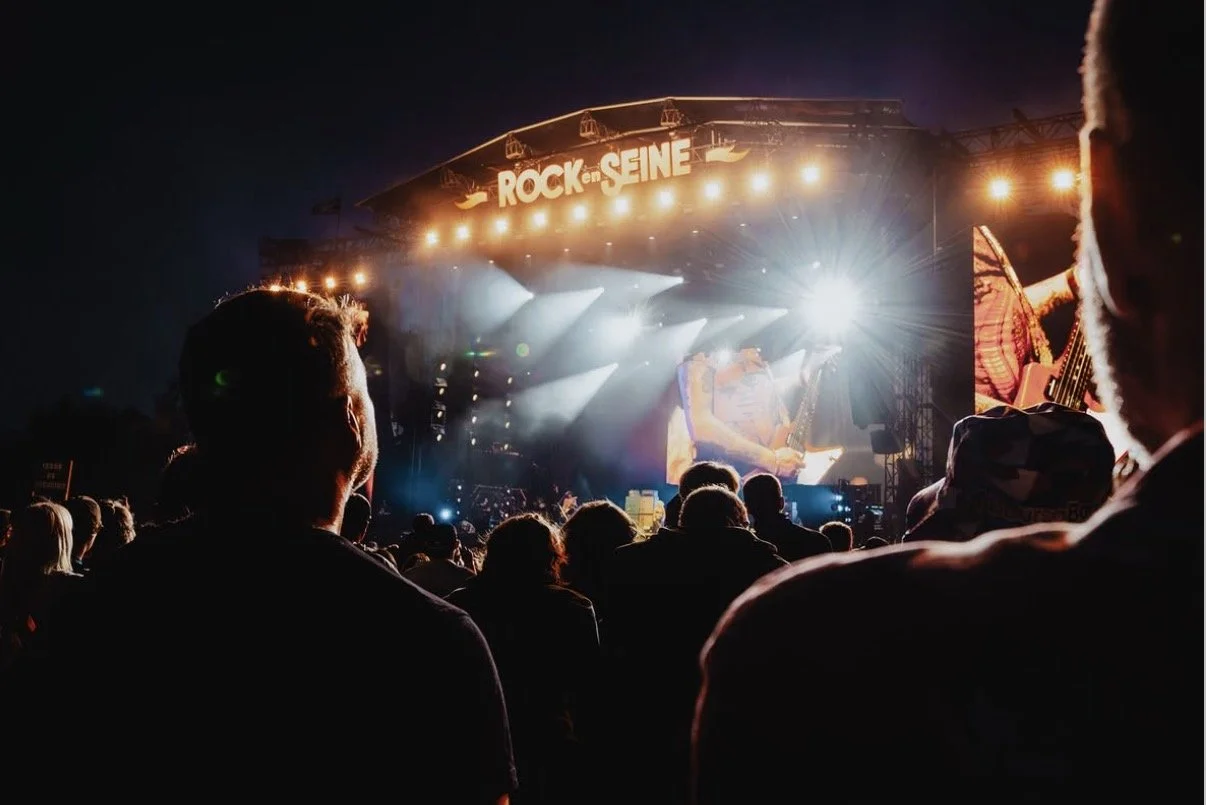
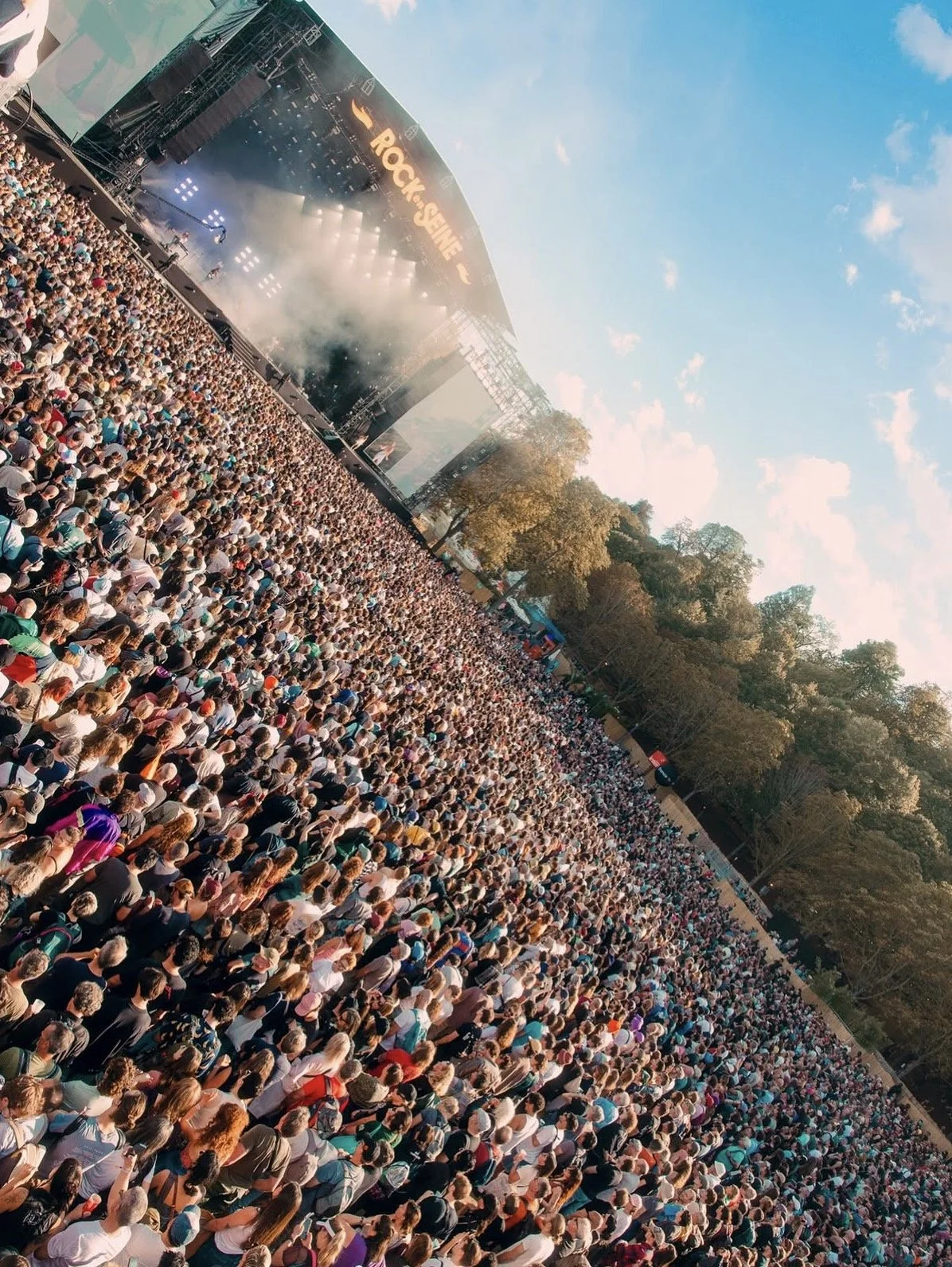
Summer does not end quietly at Rock en Seine. For five days, the Domaine national de Saint-Cloud became a collision point for pop, rock, rap and everything in between, pulling 175,000 people across four stages and more than 70 performances.
By now, the festival no longer needs to prove its scale. What matters is how it uses it. Rock en Seine 2026 felt strongest when its huge crowds, legacy names and emerging artists existed side by side without cancelling each other out. Big productions met rawer sets, obvious headliners gave way to unexpected discoveries, and the most memorable moments were not always the ones printed largest on the poster.
Across a week of unstable weather, packed stages and very different energies, these were the performances that gave the 2026 edition its character.
Magi Merlin was one of those artists we were especially curious to see translate her world onto the Rock en Seine stage. When we spoke to her ahead of the festival, she described music, clothes, hair, makeup and physical objects as different parts of the same language, a way of giving visual form to what her music sounds like. She also spoke about calling herself the artistic director of her own project, spending over a year building the universe around her record and insisting on making things tangible and real in an increasingly synthetic landscape. On stage, that philosophy made perfect sense. Merlin was magnetic, playful and completely at ease with the unpredictability she had promised us: screaming, moving, interacting with her band and, above all, letting go. If anything, the setting struggled to keep up with her. For an artist whose work is so deeply rooted in image-making and world-building, we couldn’t help but wish she had been given a stage with screens and a stronger visual infrastructure, something capable of expanding that universe beyond the performance itself. The energy was already there; with the right visual canvas, it could have exploded.
Elsewhere, Ravyn Lenae and sombr proved that having a clear lane of your own remains one of the most exciting things to watch at a festival. Lenae arrived at Rock en Seine ready to open the world of her new album, "Blue Island", dressed in Nia de Fer and performing across a multi-level stage that gave her songs room to breathe, move and unfold. There was a precision to the whole proposition (from the styling to the staging) that made the performance feel less like a simple festival set and more like an introduction to the next chapter of her universe.
sombr, meanwhile, increasingly feels like he is on his way to becoming one of the defining pop figures of his generation. The songs already have the scale, immediacy and emotional pull to justify it, even if the moments in between didn’t always match their energy. His interactions with the crowd could feel surprisingly flat and repetitive compared with the drama and momentum of the music itself, creating a strange drop whenever a song ended. Still, presence is something that can grow and the foundations of something much bigger are clearly there. Besides, he walked onstage looking spectacular in Valentino, which, for the purposes of this review, fixes almost everything.
Tyler, The Creator provided exactly the kind of disruption Rock en Seine needed after dinner. If there was ever a moment for the festival to wake back up, this was it. His set was relentless, pulling heavily from CHROMAKOPIA and DON’T TAP THE GLASS with tracks like “St. Chroma,” “Rah Tah Tah,” “Noid,” “Sticky” and “Sugar On My Tongue,” while refusing to neglect the songs that have defined different stages of his career. “EARFQUAKE,” “WUSYANAME,” “BEST INTEREST,” “She” and “ARE WE STILL FRIENDS?” turned the set into something closer to a collective release than a simple headline performance. It was arguably the safest bet of the weekend for a younger crowd, but safe hardly meant predictable: Tyler had thousands of people jumping harder than anyone else at the festival, with more than one mosh pit opening along the way. What made the setlist work so well was its refusal to settle into nostalgia or become a showcase for the latest record alone. Instead, Tyler moved through different versions of himself (abrasive, romantic, chaotic, introspective) before songs like “NEW MAGIC WAND” pushed that tension back towards pure physical energy. Few artists at Rock en Seine understood the scale of the occasion quite as instinctively. At that hour, subtlety could wait; what we needed was someone to blow the evening wide open.
Day two began with a dilemma: Jean Dawson or Changeline. Two artists with radically different ways of occupying a stage, and two propositions we weren’t willing to sacrifice, so we did what festivals force you to do and split our time between both. If that meant experiencing each set only partially, it also captured something essential about Rock en Seine: constantly moving between sounds, identities and performances that seem to exist in entirely separate worlds.
Parsa Sabet, however, demanded stillness. After describing his music to us as “experimental fairytale music for lost princes and princesses,” his performance brought that definition into focus, creating one of the day’s most introspective atmospheres. The contradictions at the heart of Boyman (boyhood and adulthood, masculinity and ambiguity, belonging and displacement, instinct and structure) felt particularly compelling live. There is something deliberately unresolved about Sabet, an artist who told us that every system feels like a cage and whose work seems most comfortable precisely when it cannot be easily categorised.
Unfortunately, Rock en Seine placed that world on what might be the festival’s least forgiving stage. With no screens or meaningful visual infrastructure to expand the performance beyond its physical limits, Sabet was denied a tool that feels almost essential for an artist whose project extends into fashion, imagery and self-presentation. Much like with Magi Merlin, it exposed one of the festival’s recurring weaknesses: booking artists with carefully constructed visual universes without always giving them the architecture to fully inhabit them. Sabet still managed to pull the audience inward, but one was left imagining how much further his strange, melancholic fairytale could have gone if the stage had allowed it.
One performance that deserves its own paragraph is Lykke Li’s. Few artists have shaped contemporary pop’s emotional language as profoundly as she has, and her set arrived at exactly the right moment: in the middle of the storm, wrapped in a waterproof sports ensemble that turned the weather into part of the performance rather than an obstacle. There was something strangely iconic about watching her deliver timeless songs while introducing material from The Afterparty, embracing the rain instead of resisting it. The whole image inevitably recalled Central Cee’s now-famous Quechua era, technical outdoorwear elevated into pop iconography. With Lykke Li, though, functionality never came at the expense of elegance; it simply became another way of proving that great pop survives any weather.
Lorde closed the festival’s second night with what might have been its most contemporary show; not simply in sound, but in its understanding of how we consume performance today. Conceived with production designer Tino Schaedler, the staging turned screens from supporting visuals into part of the show’s language. Cameras, projections and the physical stage constantly reframed Lorde, forcing us to negotiate between watching the person in front of us and the mediated version towering above her. At times clinical, almost scientific or robotic, the production could have easily created distance. Instead, the opposite happened. That cold visual architecture became the container for an intensely emotional performance, confronted by an audience ready to give absolutely everything back.
The setlist made that exchange even more powerful. Rather than treating her catalogue as a sequence of eras to revisit, Lorde folded them into one another: Virgin material such as “What Was That,” “Broken Glass,” “Shapeshifter,” “Favourite Daughter” and “Man of the Year” sat alongside the adolescent mythology of “Royals,” “Team” and “Ribs,” the emotional maximalism of Melodrama through “The Louvre,” “Liability,” “Supercut” and “Green Light,” and even Solar Power’s “Oceanic Feeling.” “Girl, so confusing” (her generational collision with Charli xcx) almost inevitably belonged there too. The result felt less like a greatest-hits retrospective than watching more than a decade of Lorde collapse into the same present tense. There was something fascinating about thousands of people reaching for something so deeply human through a show obsessed with mediation, technology and the image. If contemporary pop performance is increasingly about what happens between the body, the camera, the screen and the person watching it, Lorde seemed to understand that relationship better than anyone else we saw that weekend.
By day three, the festival started to feel much calmer, at least from my perspective. Wet Leg brought the necessary jolt, throwing themselves completely into a set built around "moisturizer" and proving how naturally their new material has grown into the scale of a festival stage. It was confident, immediate and refreshingly uncomplicated: a band increasingly comfortable with how big they have become, without losing the slightly unruly energy that made them exciting in the first place.
Then came La Flemme, easily one of the weekend’s most hyped smaller bands, carrying a very different kind of energy from Marseille into a Paris that, by comparison, can sometimes feel almost suspiciously well-behaved. When we spoke to them, they insisted that La Flemme simply could not have emerged in the same way in the capital: Marseille’s concentrated rock scene, where venues sit minutes apart and bands constantly feed off one another, is embedded in their identity. Live, you understood exactly what they meant. Their collision of garage, pop and psychedelia feels less like a calculated revival than the product of a scene; messy, communal and proudly imperfect. For a band whose members joked that their recurring lyrical theme is essentially “not being a functioning animal,” there is actually something very alive about them. For a moment, they managed to inject some much-needed Marseille spirit into an inhospitable, slightly under-seasoned Paris.
Nick Cave and the Bad Seeds brought the night to a completely different conclusion. An enormous, genuinely intergenerational crowd gathered in front of the main stage, and watching it from within was almost as fascinating as watching Cave himself. This is not necessarily music I personally connect with, but some performances make personal taste almost irrelevant. Cave seemed physically pulled towards his audience by the music, constantly reaching into it until eventually he was quite literally being carried across it; crowd-surfing, or at least doing his best approximation of it (I was so worry about his health, really). There was something moving about seeing an artist with such a long career still surrender himself so completely to the people in front of him, while teenagers and longtime devotees appeared equally invested in the ritual. It might not have been my church, but Cave was preaching and I’ll happily give him his flowers.
By day four, the festival was starting to weigh on the body. The kilometres, the crowds and three previous days of running between stages were catching up with us, and the pace inevitably became slower. Clipse, however, gave us every reason to pay attention. Their set felt both memorable and historically conscious, placing Black American culture at its centre without diluting it for the largely white European crowd standing in front of them. Through lyrics and visuals, Pusha T and Malice built a performance filled with references to Black history, faith, success, violence and survival. In that context, the experience inevitably changed depending on who was watching. For much of the Rock en Seine audience, this was not a moment of shared cultural identification, nor should we pretend it was. It was closer to witnessing, listening and learning: the message felt revealing rather than communal, a culture being articulated on its own terms rather than reshaped to make everyone feel included.
Later, Turnstile and Deftones shifted the emphasis back towards the sheer physicality of live music. Both drew remarkably intergenerational crowds, but without turning their sets into exercises in nostalgia. Instead, guitars, drums, volume and bodies became the spectacle. There was something refreshing about watching different generations respond to heavy music with essentially the same instinct, particularly at a festival where screens and elaborate visual worlds had played such an important role elsewhere. Turnstile brought movement and urgency; Deftones offered the weight and atmosphere of a catalogue that continues to find new audiences decades later. Strangely, despite those three performances (that I attended), day four remained one of our more relaxed days at Rock en Seine. Maybe exhaustion had finally won, or maybe sometimes the best way to experience a festival is simply to stop chasing every possible moment and let the music come to you.
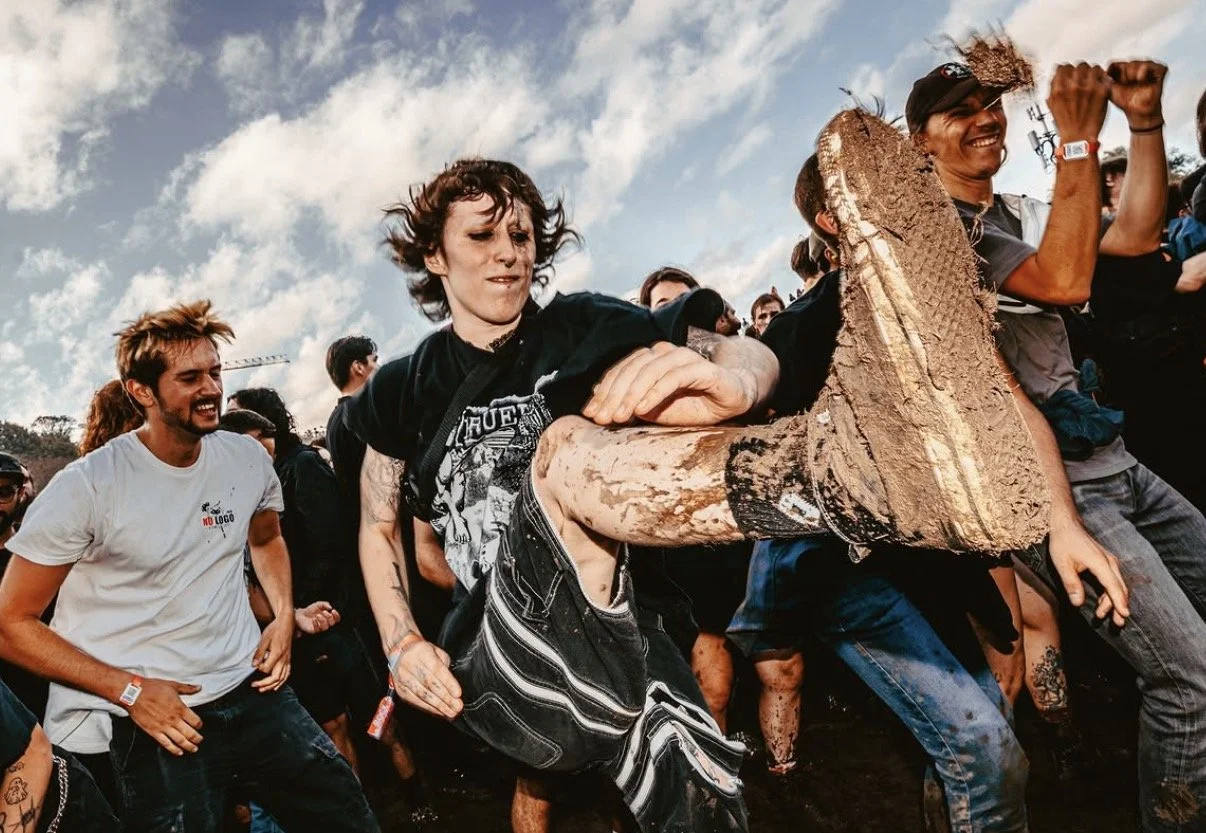
And then, somehow, day five arrived. The light at the end of the tunnel was finally visible, and my shoes were begging to be washed after absorbing what felt like half of Saint-Cloud over the previous week; Thursday’s storm had made sure the mud became as much a part of Rock en Seine 2026 as any of its headliners. Exhaustion was real, but the final day still had some of the festival’s most rewarding performances waiting for us.
Anna von Hausswolff was one of them. Her live show was raw, direct and almost overwhelming in the way sound and image were allowed to consume the space. Rather than simply accompanying the music, the visuals seemed to intensify its physicality, pushing an already uncompromising performance somewhere darker and stranger. It was one of those sets where atmosphere becomes almost architectural. My only frustration was the styling: considering how fully realised everything else felt, I wanted the clothes to participate in that world with the same intensity. When sound, lighting and visuals are operating at that level, wardrobe suddenly stops feeling like a detail.
At almost exactly the same time, Wolf Alice were creating something entirely different; and, for me, one of the highlights of the entire festival. Their set had the scale of a proper rock show without losing its intimacy, crowned by that enormous star covered in silver confetti that turned the stage into an unexpectedly magical spectacle. Then there were the clothes: effortless, slightly undone and cool enough that my main takeaway was simply that somebody needs to put Wolf Alice and Gimaguas in a room together immediately. Consider this my formal request for the collaboration.
The Cure may have been one of the defining attractions of this year’s edition, but they were not the band that closed Rock en Seine for me. That privilege went to Ditter and, in retrospect, there was something fitting about it. When we spoke before their performance, the trio told us that this show marked the end of a chapter: three years after first playing the festival, and roughly 200 concerts later, they were returning to Rock en Seine for the final date of their French tour. A project that began almost as an excuse to have fun has developed into something increasingly difficult to look away from.
That evolution was palpable live. Ditter’s collision of funk, pop and club music feels made for bodies rather than algorithms, even if the band themselves readily admit how deeply the internet has shaped them, they learned to make music through YouTube, discover new sounds through Instagram and still cringe at seeing their own faces online. More interestingly, they told us that after hundreds of concerts, the relationship between stage and studio has started to reverse: unreleased songs are tested on audiences, reactions reshape arrangements, and the live show feeds directly back into what Ditter becomes next. Watching them, that feedback loop made complete sense. Nothing felt fixed.
Perhaps that is why they felt like the right ending. After five days of watching artists negotiate spectacle, screens, fashion, nostalgia, community and the increasingly complicated business of being seen, Ditter closed our Rock en Seine with something still visibly in motion. The Cure might have carried the history, but I left thinking about what comes next. Three years and 200 shows into Ditter’s story, I’m keeping my eyes firmly on them and whatever they release next, I’ll be there.
Words by @alraco43