
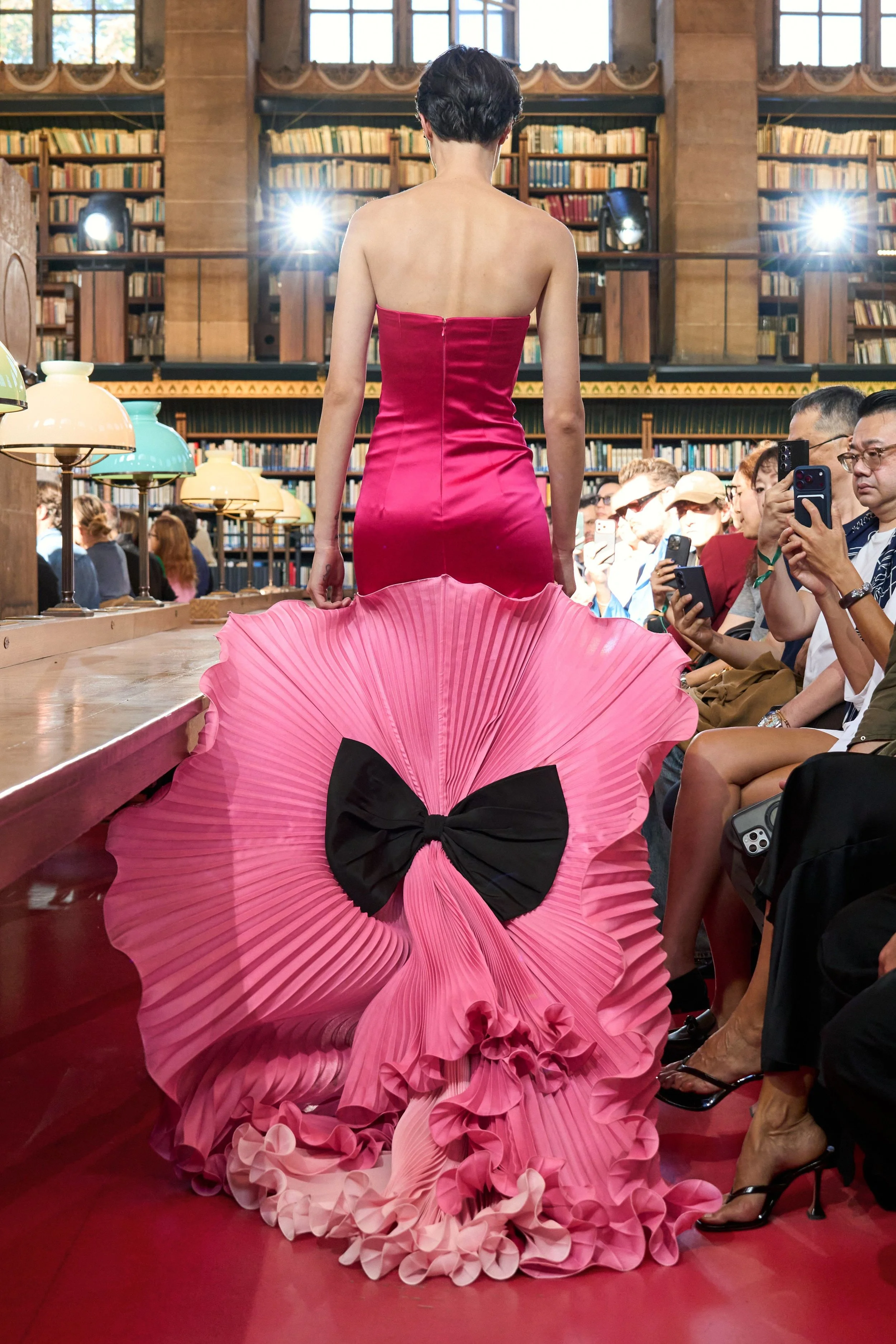
To better understand this critique, we need to start with the most fundamental element underpinning the entire analysis: the fashion show. A fashion show is a fashion house’s most important communication tool, as it presents a collection as a unified whole, built around a particular aesthetic, cultural and conceptual vision that should evoke feelings in the person experiencing it. The set design, makeup, hairstyling, garments, guest list and garment notes all work together to construct a narrative that must be closely connected to the brand. However, when an established fashion house such as Valentino appoints a new creative director, a question inevitably arises, and it is this question that prompted the present analysis: to what extent can its visual language be transformed without losing the codes that have made it a recognisable brand?
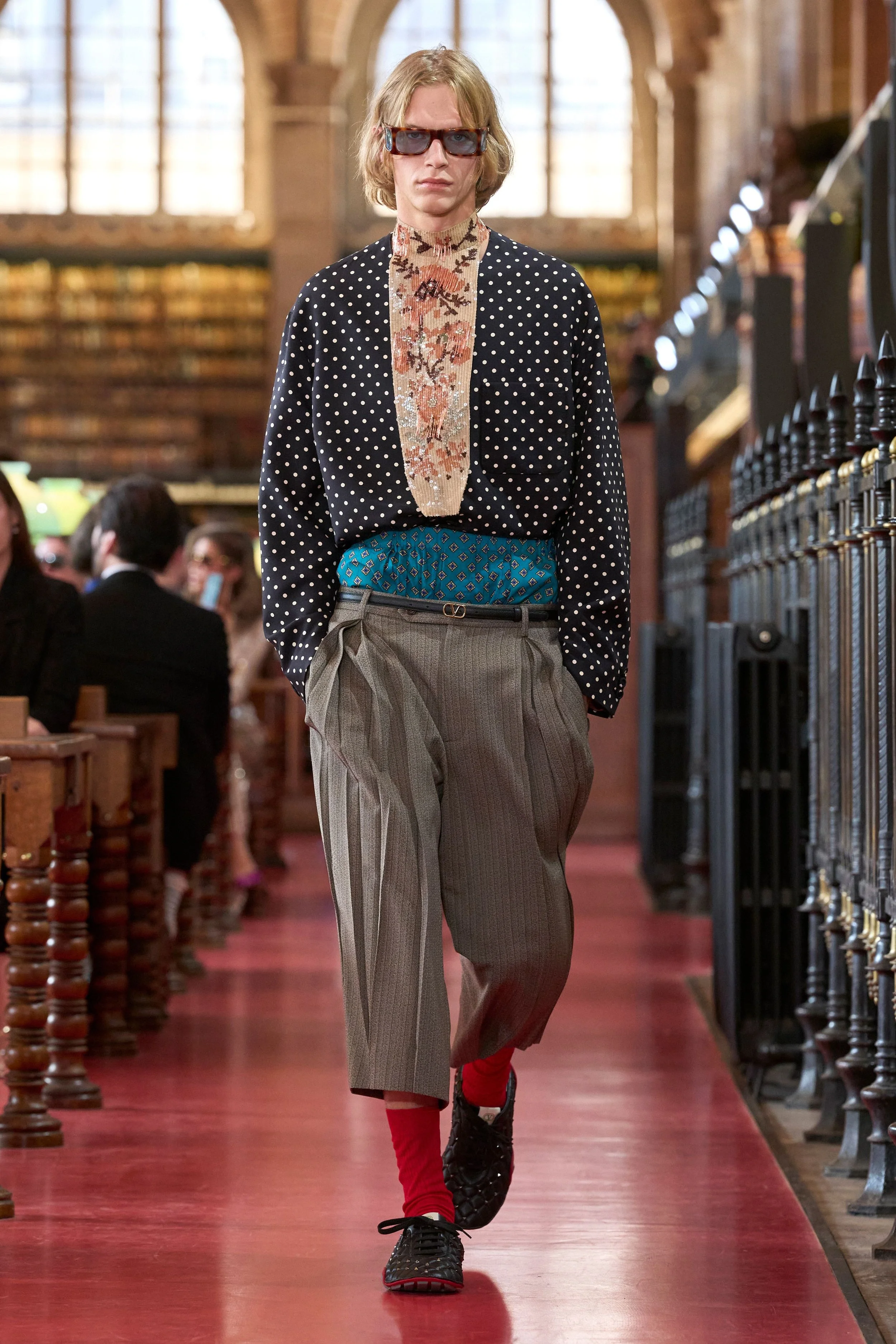
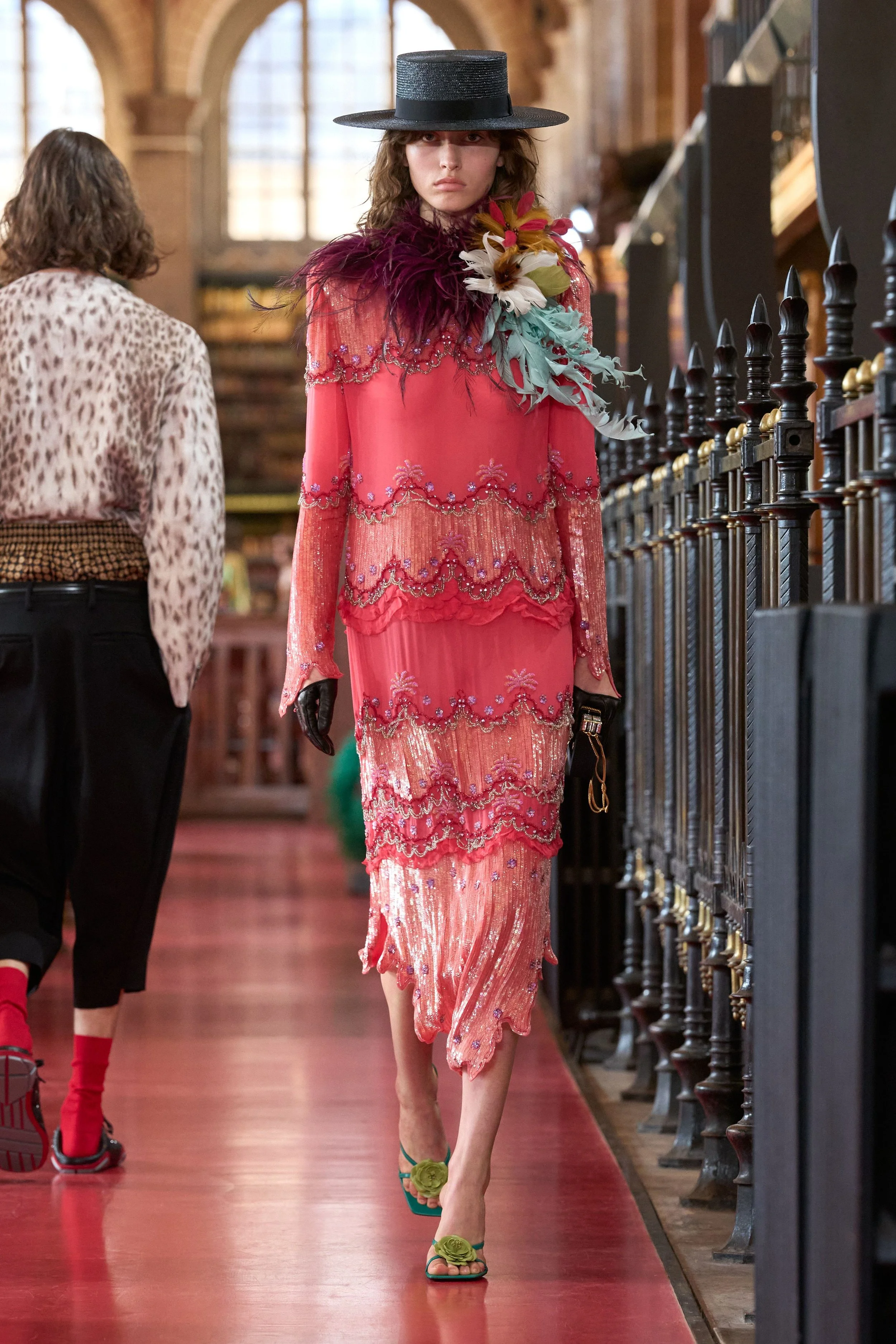
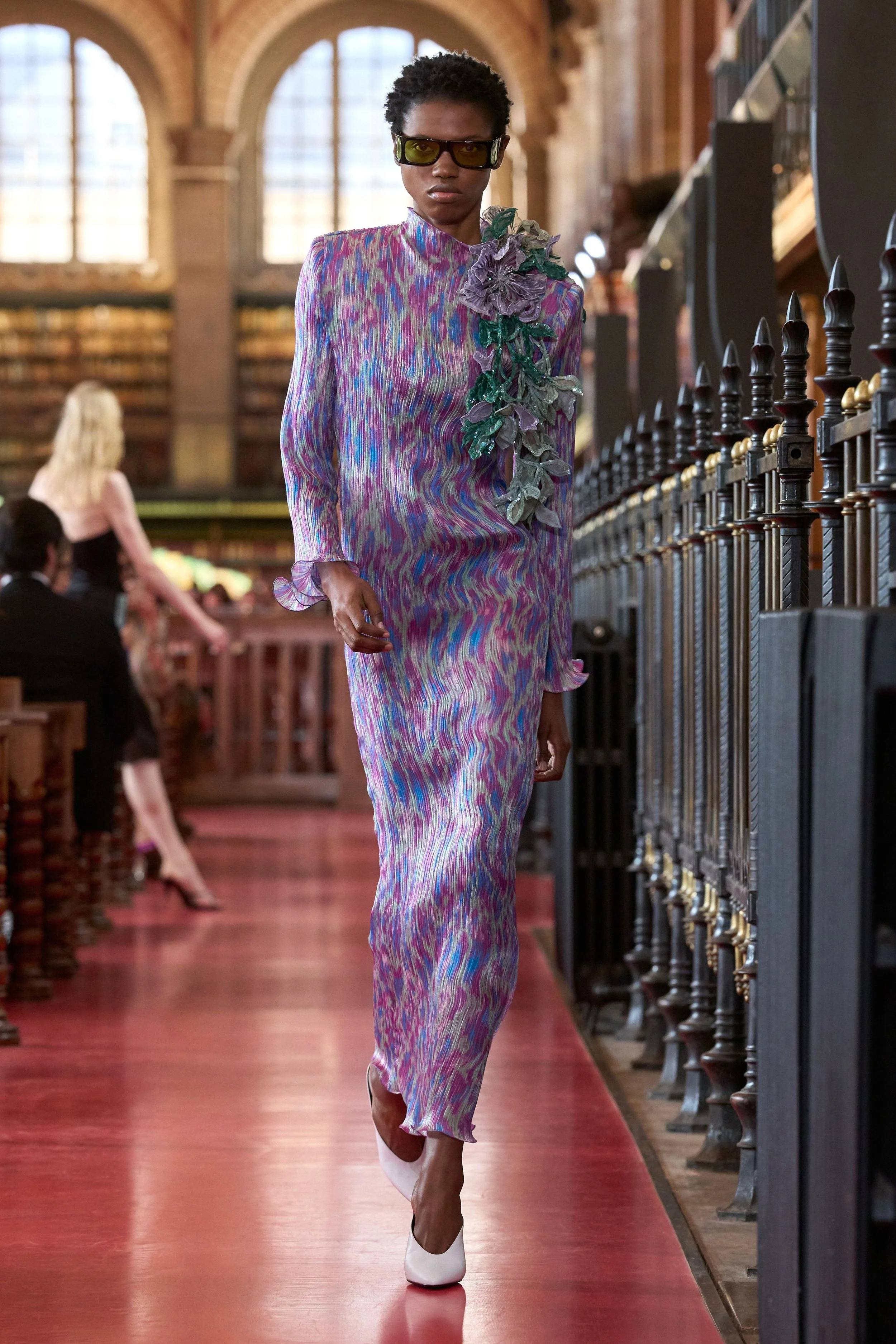
This question becomes particularly apparent when analysing Valentino’s latest collection, presented by Alessandro Michele during Paris Fashion Week under the title “Antibiblioteca”. The collection revolves around a reflection on literature, knowledge and the possibilities that have yet to be explored. To develop this concept, Alessandro chose the Bibliothèque Sainte-Geneviève in Paris as the setting and presented a collection characterised by a mixture of very different aesthetic references. Although the show has a recognisable concept and a creative identity consistent with Alessandro’s career, his proposal raises questions about the continuity of Valentino’s legacy. The designer’s aesthetic, defined by eclecticism, the accumulation of references and a taste for contrasts, takes centre stage to such an extent that the maison’s historical codes become difficult to identify.
To understand the potential contradictions, it is necessary to consider the differences between the two designers. The maison was founded in Rome in 1960 by Valentino Garavani, who built a fashion house recognised worldwide for its elegance, sophistication and dedication to Haute Couture. Throughout his career, Valentino developed a visual language associated with refined silhouettes, attention to fabrics, craftsmanship and an understanding of femininity linked to glamour and elegance. Valentino red also became one of the brand’s most recognisable visual codes. Interestingly, however, it does not appear in a single look from the latest runway collection.
Nevertheless, it would be incorrect to interpret this identity as an unbearable aesthetic or to claim that Valentino has always championed a minimalist image. The maison’s history includes ornamental designs, experiments with colour and dresses featuring elaborate decoration. Its identity does not depend exclusively on a silhouette or colour palette, but rather on a combination of visual codes, quality of execution and a particular conception of the luxury surrounding it.
Following Valentino’s retirement, different creative directors reinterpreted his legacy. Among them, Pierpaolo Piccioli developed a period characterised by his sensitivity to colour, the expressiveness of silhouettes and a contemporary interpretation of femininity, as seen in collections such as “Valentino Pink” and the Haute Couture runway “Un Château”. Alessandro Michele, for his part, developed a particularly recognisable creative language during his time at Gucci. His approach was characterised by the combination of historical references, the accumulation of ornamentation, an interest in cultural objects and the coexistence of elements belonging to different aesthetic worlds, as is the case in his latest collection. In his collections, identity is often constructed through the layering of references and the creation of visually complex characters.
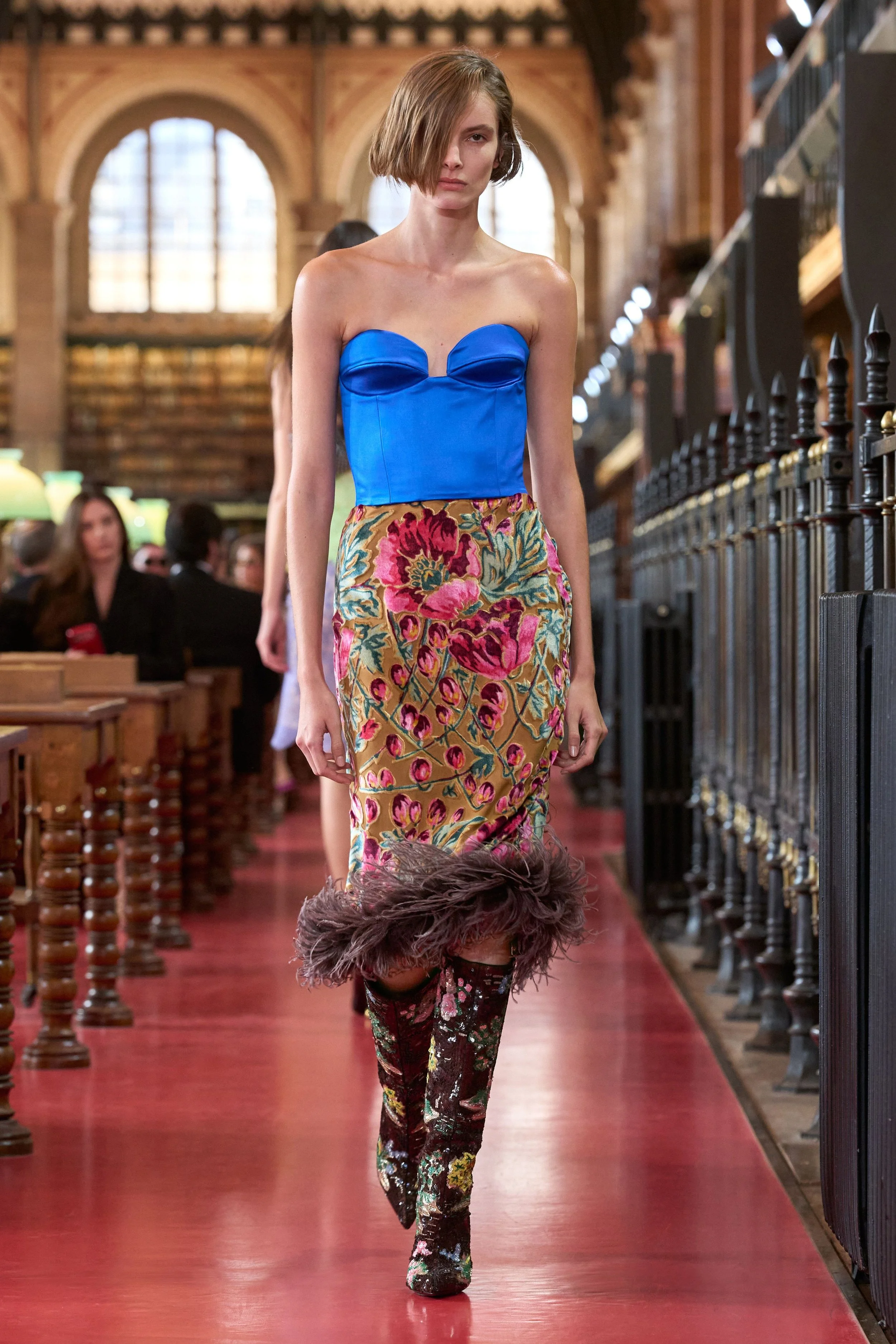
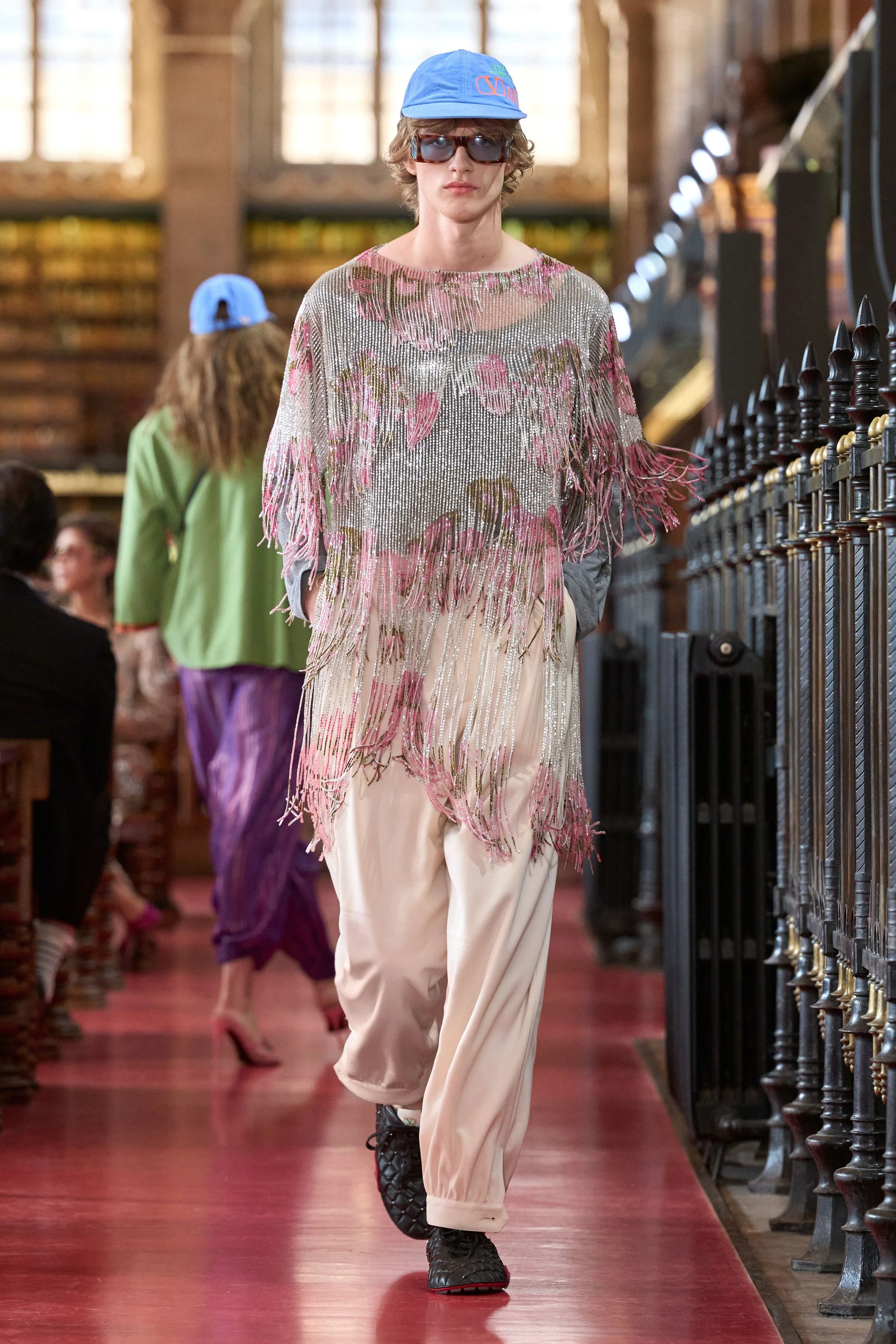
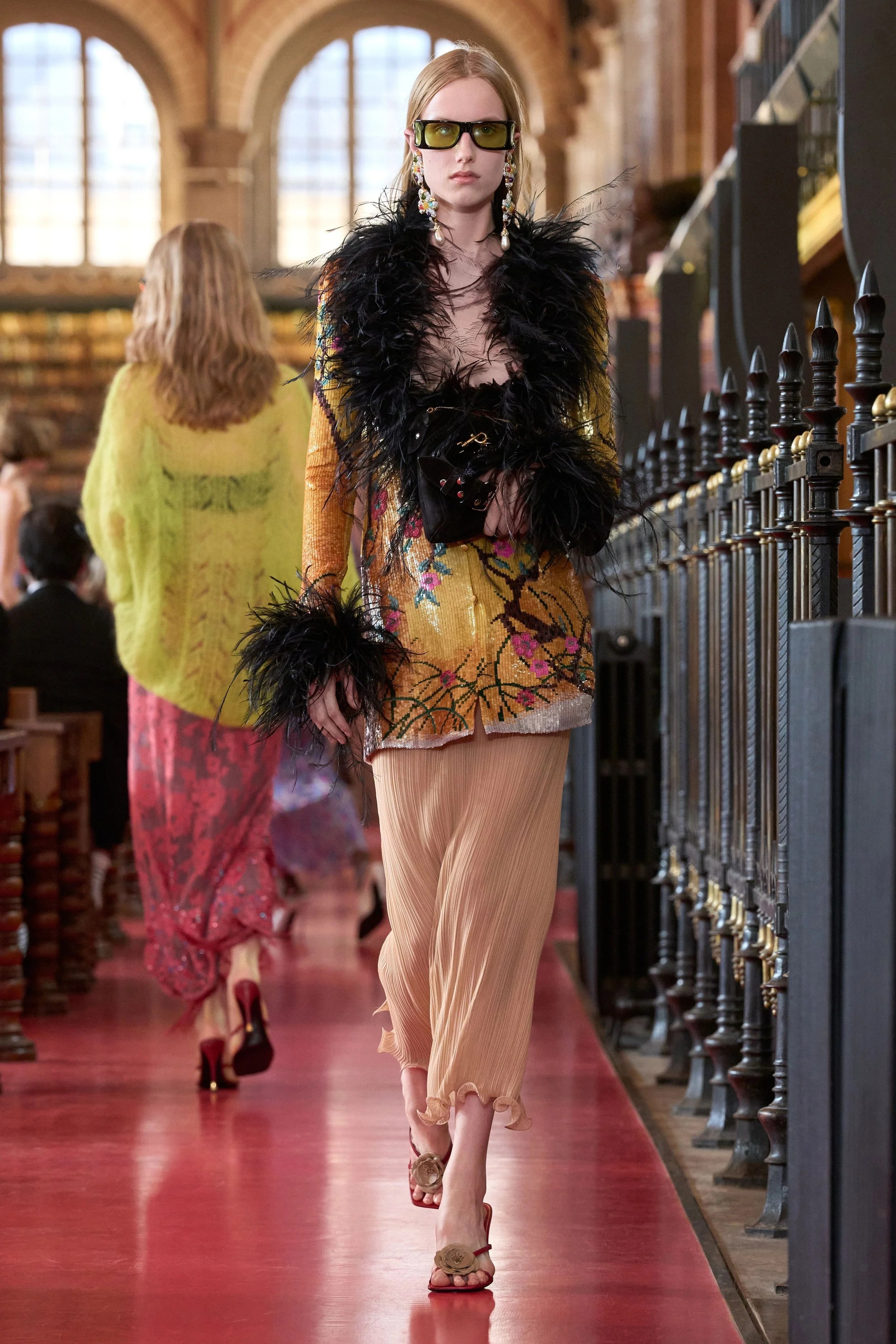
Although this approach may open up new possibilities for Valentino, it also creates tension between the designer’s personal identity and that of the maison. The problem is not that Alessandro has a different style from Valentino, since evolution is part of the history of any fashion house, and it would be counterproductive to claim that a brand must remain trapped in the aesthetic it has always had. The question is whether the designer’s personal style is being used to reinterpret the house’s codes, or whether it eventually takes over to the point where the brand itself ceases to be the collection’s main point of reference.
Looking closely at the collection, we can see satin corsets, embellished skirts, lace, feathers, sequins, striking accessories and youthful references. It also incorporates chromatic and stylistic contrasts that create a heterogeneous image. This diversity is one of the most characteristic features of Alessandro Michele’s visual language, as his approach to fashion is often based on the coexistence of elements that do not belong to the same aesthetic tradition.
In principle, this mixture does not necessarily have to be incompatible with Valentino. The maison has historically worked with these very elements. Therefore, the problem is not their decorative presence, but rather the role they play within the collection and how closely they relate to the brand itself.
Valentino’s elegance should not be confused with an absence of ornamentation. A dress can feature intricate embroidery, shiny fabrics or striking details and still convey sophistication, provided these elements are integrated coherently. The question is whether the decoration enhances the shape and character of the garment or becomes the main device used to create visual impact.
In Antibiblioteca, the coexistence of such diverse references can be interpreted as a celebration of aesthetic diversity. However, it can also create a sense of fragmentation when the viewer’s eye becomes overwhelmed throughout the show and it seems as though every element passing by is competing for their attention. Rather than constructing a recognisable image of Valentino, certain looks are perceived more as individual expressions of Alessandro’s own universe.
This distinction matters because a collection is not simply made up of individual garments. Its coherence also depends on the relationship between the looks, the continuity of the silhouettes and the way in which the different elements contribute to building a shared identity.
Another aspect worth analysing is the relationship between the garments and the conception of luxury that the brand carries with it. Valentino has built much of its prestige through the refinement of its materials, attention to finishing and a sophisticated image. Although contemporary luxury can be expressed in many different ways, a proposal that relies excessively on visual impact shifts the focus away from garment construction and towards the accumulation of references and accessories.
This is not to suggest that the collection lacks craftsmanship or technical quality, something that cannot be determined solely from images of the show. The criticism concerns the overall impression created by its visual language and the possibility that ornamentation may end up taking precedence over the maison’s historical codes, which provide continuity and allow it to keep exploring similar directions.
The choice of the Bibliothèque Sainte-Geneviève in Paris is one of the most significant elements of the show. The library, known for its historic architecture and cultural function, provides a setting associated with knowledge, reading and the preservation of memory. This location is directly connected to the concept of the antibiblioteca, based on the idea that the books we have not yet read represent the knowledge and possibilities that remain open to us.
From a narrative perspective, the decision is coherent. The architecture does not function merely as a visual backdrop, but as an active part of the show’s message. The Valentino maison has always championed the artistic use of historic spaces for its runway shows.
As for makeup and hairstyling, there is not much to highlight beyond simple hairstyles and different lip colours, since the garments themselves already commanded too much attention. This was quite common at Valentino, so in this respect, the connection between Alessandro Michele and the maison remains intact.
When it comes to the music, the choice of a contemporary song such as “Party” by Troye Sivan introduces a contrast with the library’s architectural solemnity. The space, traditionally associated with silence and concentration, is transformed into a stage in motion. All of this helps the audience maintain their attention throughout the show, a strategy Valentino has employed on several occasions.
The front row is also worth considering, as it is an essential element in the communication strategy of luxury fashion houses. The presence of celebrities, stylists, editors and industry professionals helps broaden the show’s reach and associates the brand with particular cultural circles. During the runway, the guests’ role takes on an additional dimension through the initiative of bringing books that would later be donated to public libraries. This gesture can be analysed primarily as a communication initiative, something that is not unlike previous initiatives seen at Valentino, such as LIFE, the association founded by Valentino himself to support AIDS research and raise awareness of the disease.
The analysis of the show allows us to conclude that Antibiblioteca is a proposal with a recognisable narrative and a strong presence of Alessandro Michele’s creative universe. The choice of location, the reflection on literature, the diversity of the garments and the book-donation initiative all come together around a shared idea: fashion as a space of possibilities in which different forms of identity can be imagined.
However, the conceptual coherence of the presentation does not eliminate the doubts surrounding the loss of the essence that makes a Valentino runway show distinctive. When the elements discussed above become the main organising principles of the proposal, there is a risk that the designer’s personality will end up overshadowing that of the fashion house. From this perspective, the problem is not that the maison is producing different garments, but rather the execution and development of the concept within the particular fashion house where it is being presented.
The set design and the garment notes illustrated this point well. Both elements function coherently within the universe of Antibiblioteca, but that coherence is established primarily around literature, culture and the idea of potential. They do not, however, demonstrate with the same clarity why this proposal represents a specific evolution of Valentino.
Words by @its_ms_barnes
Translated by @alraco43