
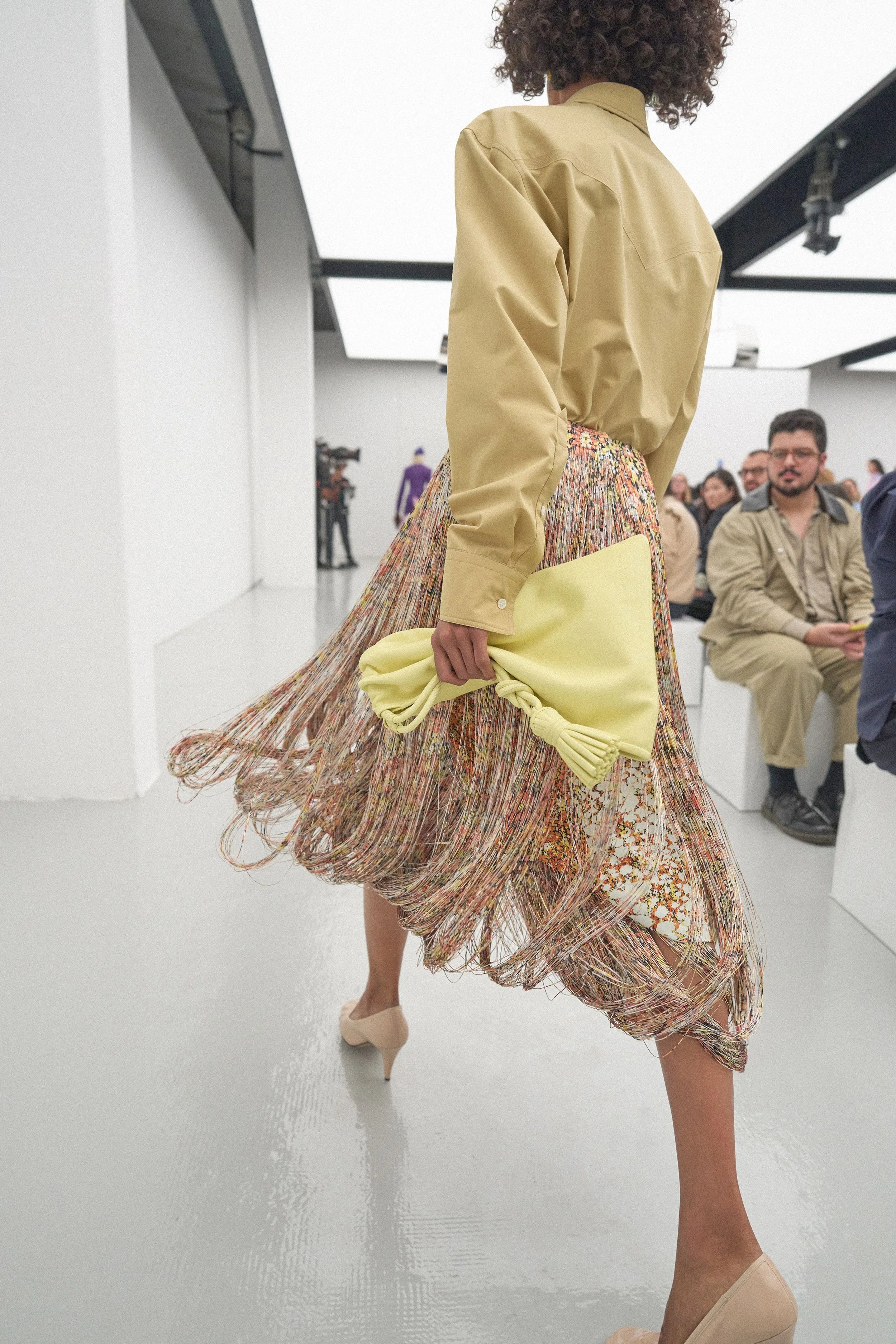
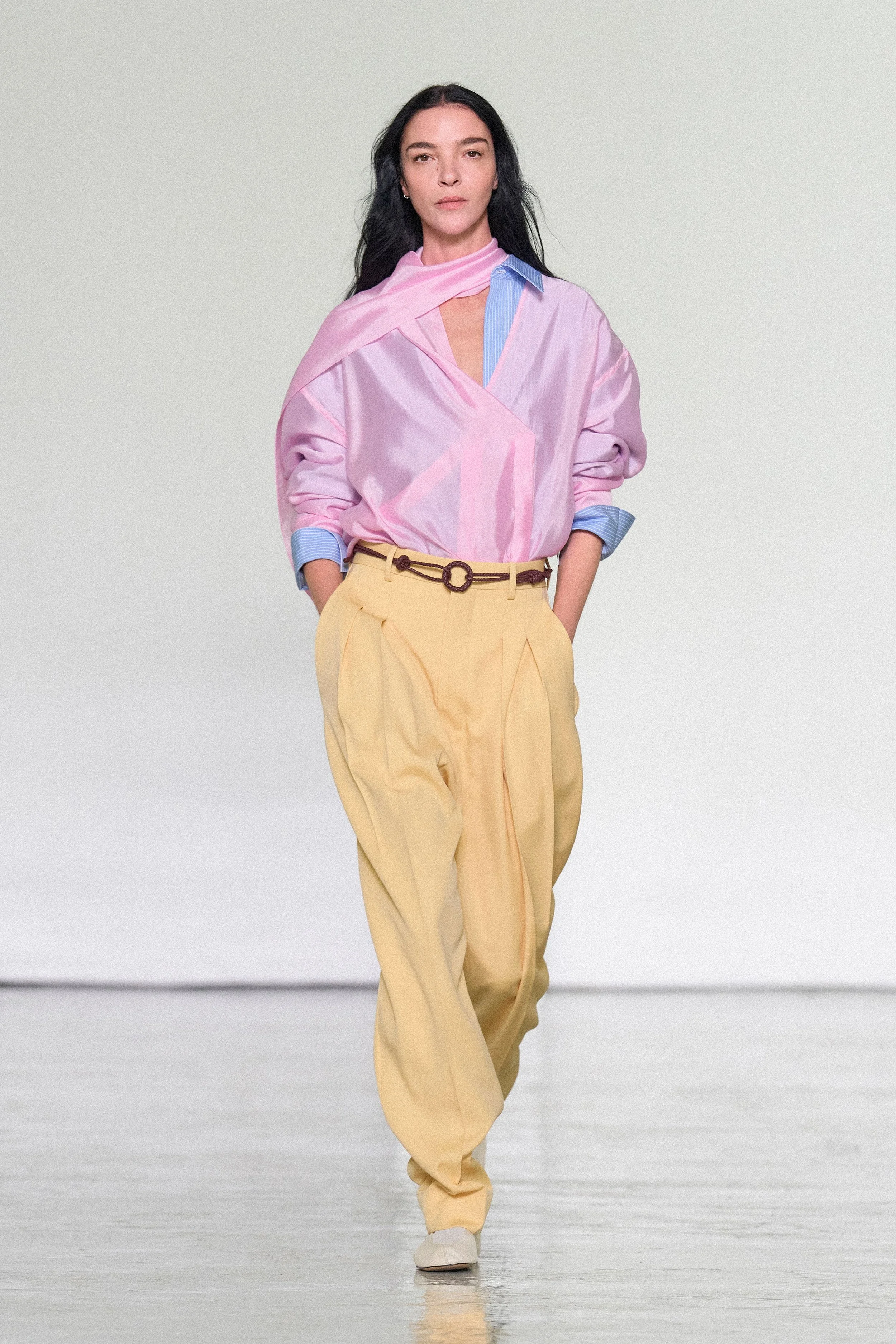
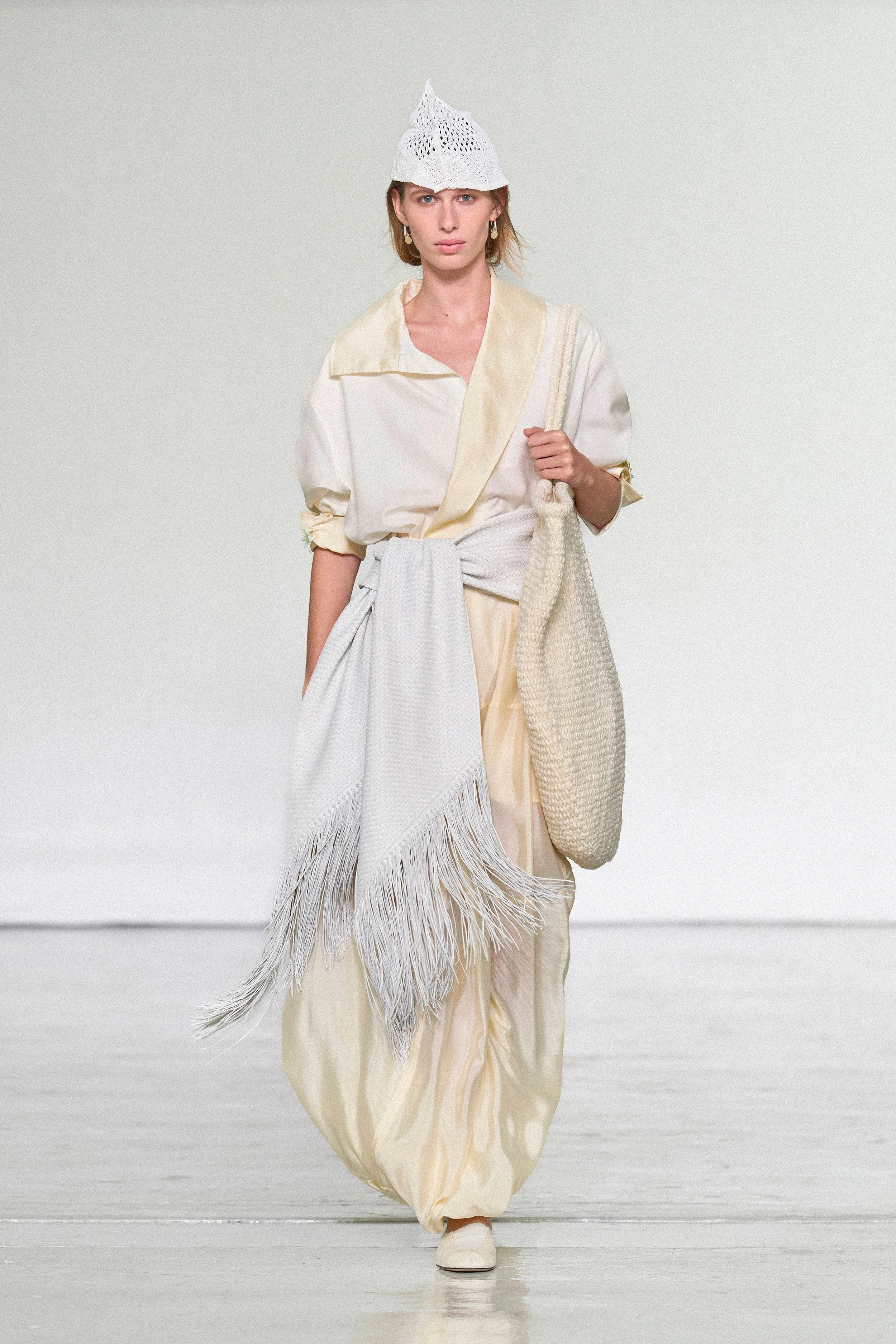
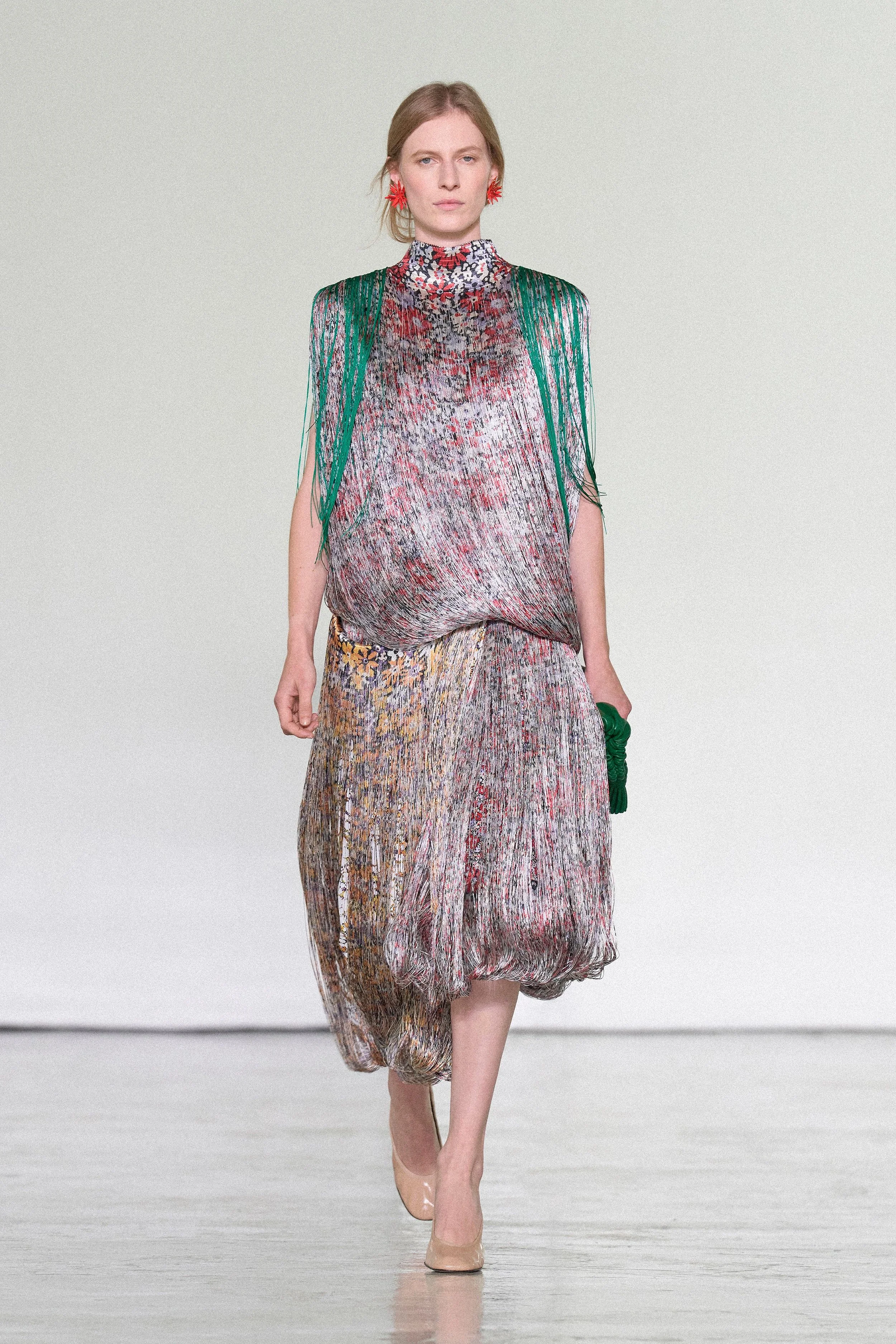
Building on Bottega Veneta’s brand identity, Louise Trotter had to create the fashion house’s latest collection for Spring/Summer 2027. In this collection, the designer develops her concept around the following idea: leaving space between the body and the clothes. This creates the overall atmosphere of the collection, moving away from rigid garments and introducing movement as one of the main elements she aims to communicate through her designs. The idea is to allow the body to move freely within the garments, without having to reveal large amounts of skin to express this sense of freedom. All of this comes together through the use of simpler yet well-defined silhouettes, trousers with greater movement and garments that appear to change as the wearer walks. The use of open-weave fabrics, crochet, fringes and draping also contributes to this effect, alongside leather, which, as previously mentioned, is one of Bottega Veneta’s most characteristic materials.
Throughout the collection, there is a fairly clear transition. It begins with more winter-inspired looks, featuring much heavier and warmer fabrics and materials, before gradually moving towards a much more summery atmosphere, with lighter fabrics and materials. Another transition can be seen in the evolution of the looks, which begin with more basic and commercial proposals and gradually introduce more distinctive and eye-catching garments that feel more desirable. Looking at the outfits in greater detail, we can see that the collection consists of a wide variety of garments, ranging from jackets and trousers to dresses and skirts, all of which vary in terms of shape, fabric and volume. At the beginning, more structured and covered-up garments predominate, while as the collection progresses, open-weave fabrics and sheer materials begin to appear.
It is also worth mentioning the different techniques used to create movement within the garments themselves. Among these, fringes stand out, creating visual effects and adding a sense of movement, particularly when combined with vibrant colours and even metallic finishes, which make the fabrics appear to change as they move. On the other hand, the collection also features materials with different textures, such as feather-like fabrics, as well as scarves and hanging fabrics that add movement as the models walk, while also elongating the silhouette and creating volume.
When it comes to makeup and hairstyling, both complement the collection through a fairly natural aesthetic that supports the looks and the overall concept. They allow the garments to stand out without taking away their protagonism, using very natural makeup focused mainly on the skin, without introducing colour on either the lips or the eyes. The hairstyles are also generally simple and natural, varying between sleek, gelled-back styles and loose hair, creating a more relaxed and even everyday appearance. It is also worth highlighting the different accessories that complete the looks, including bags in various sizes, although larger styles predominate, featuring textures created using the intrecciato technique. There are also numerous structured hats, with pointed or more square shapes, as well as sunglasses.
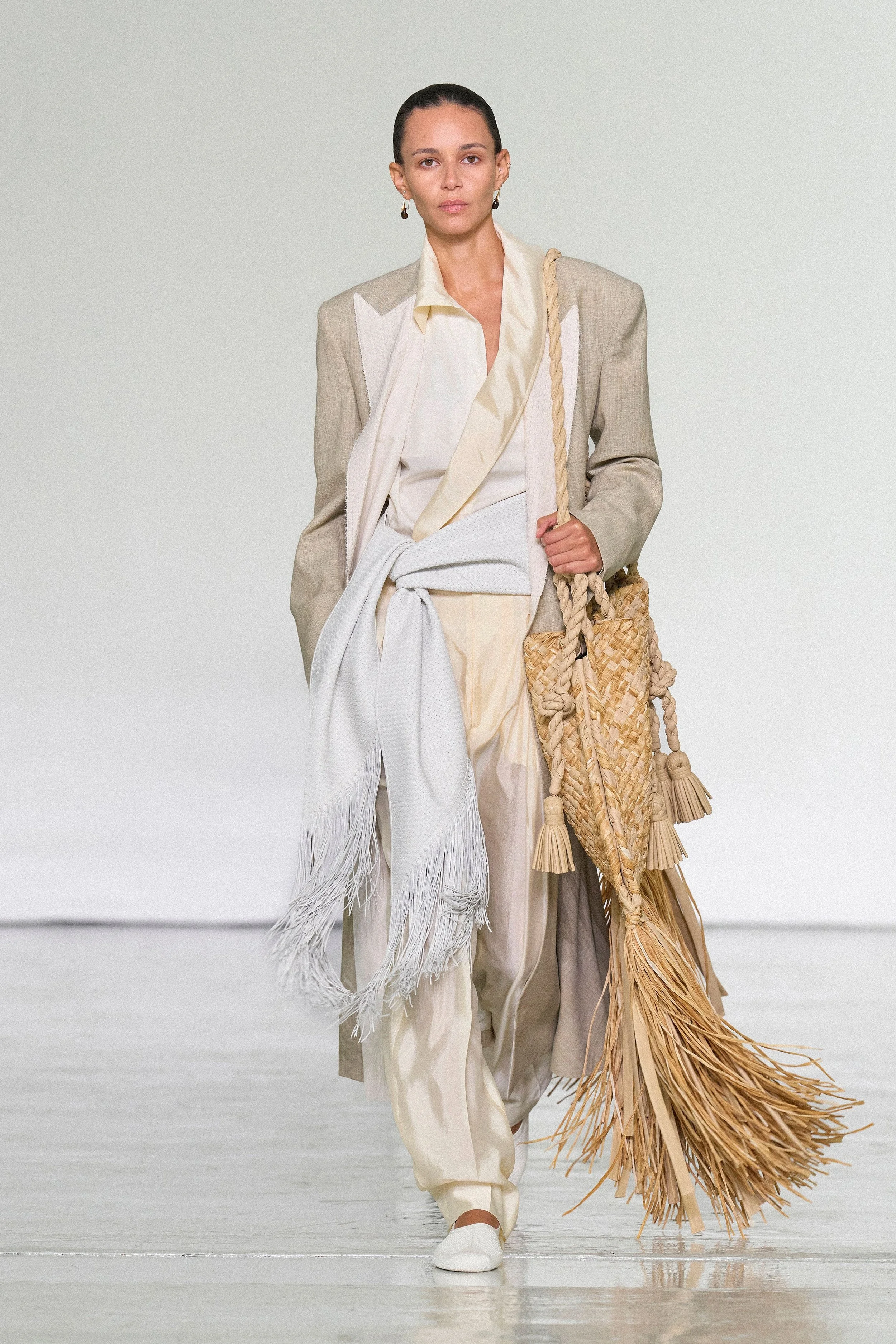
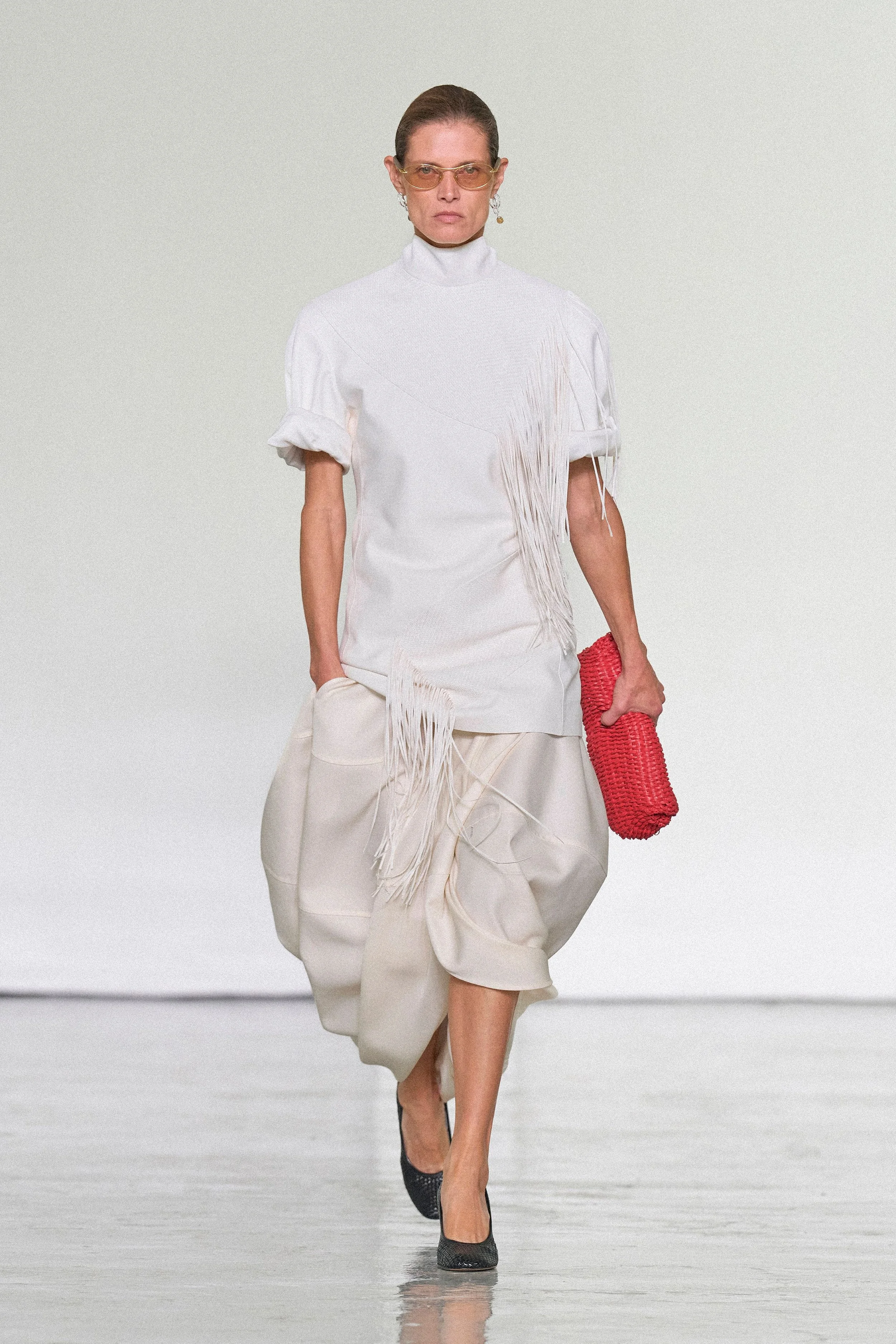
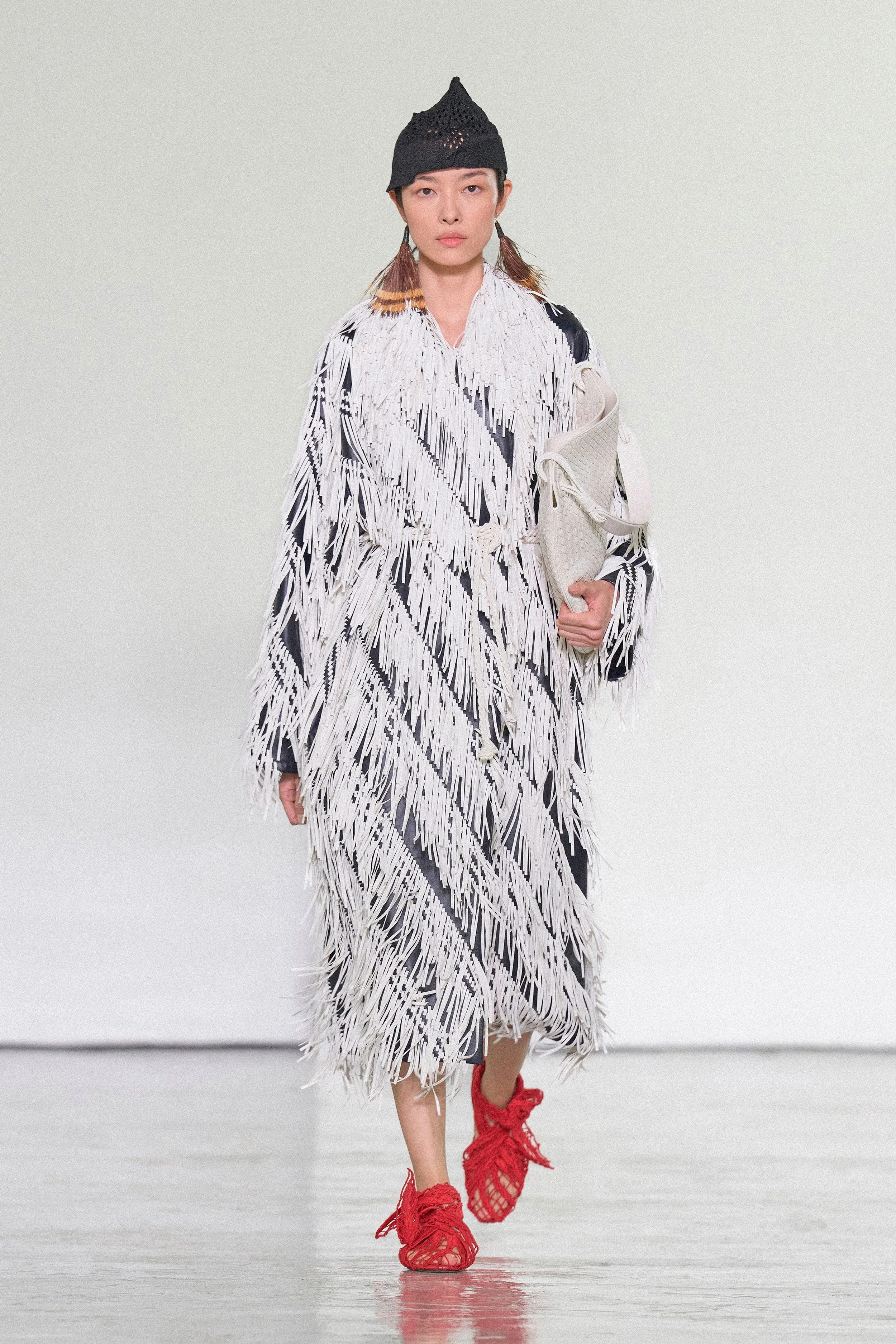
Another important aspect to highlight is the casting of the show, which featured models of different skin tones and ages, creating a diverse lineup. In addition, Kendall Jenner was among the models walking the runway, as she is a very well-known figure in the fashion industry and has considerable influence among younger audiences. In this way, the brand manages to connect with younger generations, something that is also reflected in other decisions regarding the selection of guests invited to the show, with the aim of reaching a broader audience.
The show took place at Fabbrica Orobia in Milan, inside a white space. During the presentation, a sound installation created by German artist Florian Hecker was played throughout the venue using 20 speakers. The benches designed by Illya Goldman Gubin were also part of the scenography. They were made from manually compressed cardboard boxes, covered with fibreglass and transparent resin. In addition, they were decorated with handcrafted leather flowers placed on top of them.
There is a strong connection with the brand’s origins, particularly through the importance of craftsmanship and manual work at Bottega Veneta. The scenography explores this same idea as the collection: taking something familiar, transforming it and turning it into something different through human intervention. Using everyday materials to create design objects, as seen in the benches and flowers, reinforces the idea of transforming basic elements into something more elaborate through traditional craftsmanship techniques. This concept is also directly connected to the collection, in which Louise Trotter works with materials in a different way, maintaining the essence of the fashion house while introducing her own contemporary vision.
The front row of a fashion show says a lot about the image a brand wants to communicate and the audience it hopes to connect with. At Bottega Veneta’s Spring/Summer 2027 show, some well-known faces among the guests included Julianne Moore, Tyler, the Creator and Jacob Elordi. These are three very different personalities who, consequently, bring different perspectives to the brand’s image.
As an ambassador for the fashion house, Jacob Elordi is an important figure in helping the brand connect with a younger audience and allowing Bottega Veneta to reach new generations. Furthermore, he is not associated with one particular or defined style, which means he can attract a more diverse and less restricted audience. On the other hand, Julianne Moore and Tyler, the Creator introduce a contrast, as they represent very different profiles and styles. Julianne Moore is associated with a more classic and elegant image, while Tyler, the Creator stands out for his creative, daring and even experimental side. The selection of these three personalities therefore reflects the diversity of audiences the fashion house wants to connect with, as it seeks to expand its reach towards a slightly younger audience and appeal to new generations.
The collection’s press release reflects its main concept, which revolves around freedom and the importance of leaving space between the body and the garments. Louise Trotter aims to create a lighter and more comfortable collection in which garments allow freedom of movement and adapt to the body. She makes it clear that the creative director is not trying to change the essence of Bottega Veneta, but rather to give it a new direction based on comfort, movement and the freedom of the body within clothing.
In conclusion, it is clear that Louise Trotter aims to preserve the essence of Bottega Veneta while giving it a more contemporary direction and introducing her own creative vision. Through this collection, we can see how the brand can continue to evolve without abandoning such defining elements as craftsmanship, leatherwork and attention to materials. Furthermore, the designer seeks to communicate a more comfortable and natural approach to fashion, in which garments do not have to follow traditional gender-based rules and where movement and freedom play an important role.
All of this, together with the choice of models and guests, demonstrates an intention to bring the brand closer to a younger audience without losing the identity that makes it recognisable. We can also see how this new chapter is reflected not only in the garments themselves, but also in everything surrounding the show, from the scenography to the image the brand wants to communicate. In this way, Louise Trotter gradually introduces changes while preserving the fashion house’s history.
Words by @maiderarrazola
Translated by @alraco43