
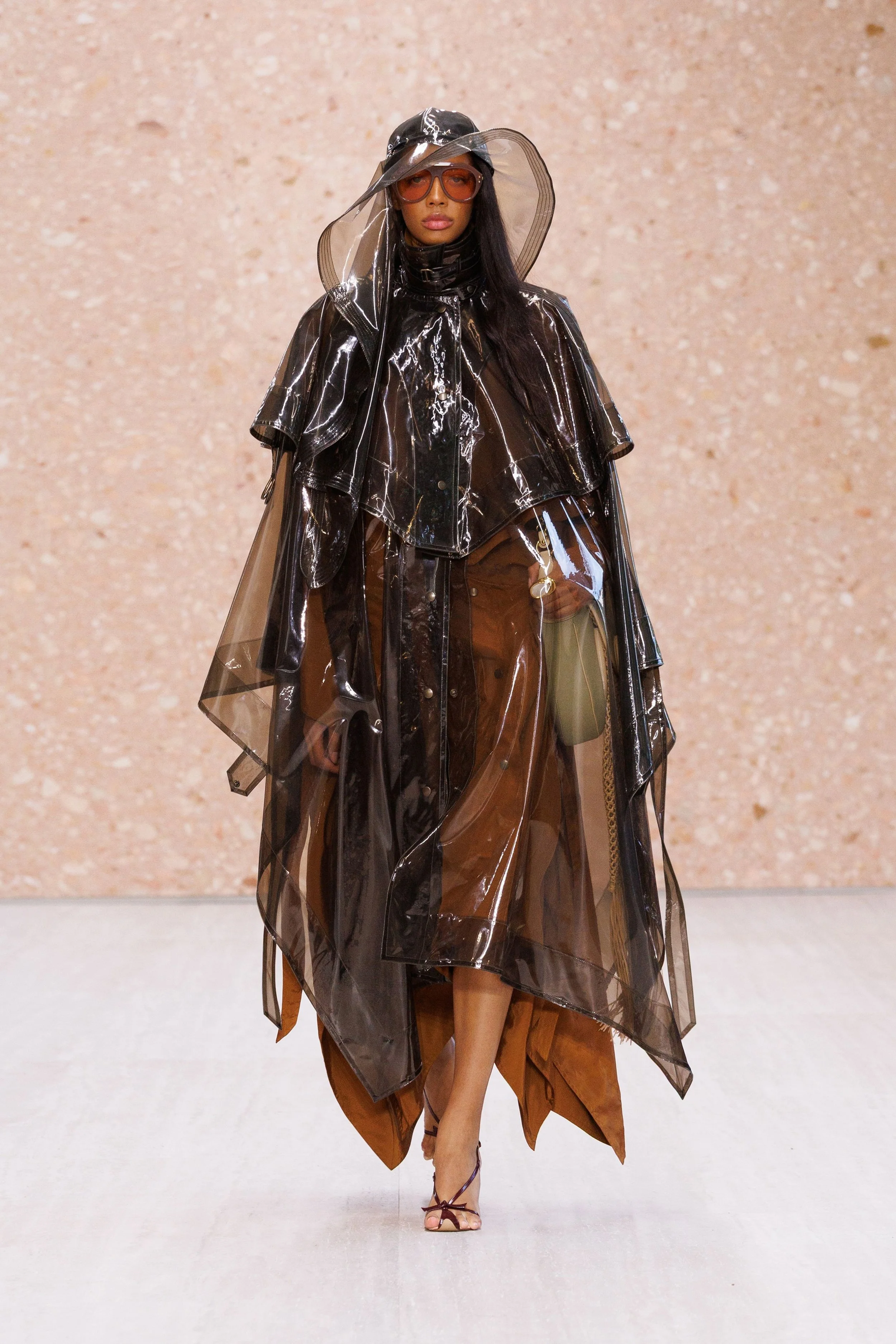
Some runway shows win you over from the very first look, while others, despite featuring interesting pieces, need something more to truly convince you. For me, Chloé’s Spring/Summer 2027 collection presented by Chemena Kamali, falls into the second category. It has details worth analysing, a recognisable visual identity, and that bohemian spirit that has become one of the house’s defining codes. However, after seeing what Kamali achieved with her Autumn/Winter 2025 debut, I can’t help but feel that this time she has fallen a little short. After all, when your first collection sets the bar so high, living up to expectations is no easy task.
The title itself, The Obsession Collection, immediately brings to mind those ideas a designer returns to again and again because they are deeply rooted in their creative universe. In this case, we find artisanal techniques, historical references, romantic garments, and a femininity that refuses to be overly polished or rigid. However, there is something I find particularly important here: the idea that obsessions can ultimately become the identity of a fashion house or designer, and there is no doubt that Kamali has achieved precisely that. For me, this is one of the most interesting, but also one of the most debatable, aspects of the collection.
To understand this, we need to look briefly at Chloé’s history. The maison was founded in Paris in 1952 by Gaby Aghion, who championed a different vision of luxury: luxury ready-to-wear, high-quality garments designed to be worn in everyday life, without the rigidity traditionally associated with haute couture. Since then, the house has built an identity rooted in femininity, freedom, and a more relaxed approach to elegance. Creative directors such as Karl Lagerfeld, Stella McCartney, and Phoebe Philo have each brought their own interpretations to this universe, proving that preserving a house’s identity does not necessarily mean repeating the same garments season after season.
Chemena Kamali knows this heritage well. Before becoming creative director, she had worked at Chloé at different stages of her career, making her return both a personal and professional milestone. Her 2025 debut as creative director, now with full creative authority, was particularly convincing because she revisited the house’s historical codes and managed to make them feel relevant again. I especially remember a white ruffled dress paired with a small black leather cape and a bold gold necklace. That look perfectly sums up what I loved about the collection: the combination of delicacy and strength. To me, that is what you call character.
On its own, the dress could have felt excessively romantic, but the leather and jewellery gave it an entirely different vibe. The chunky boots and sheer dresses also introduced a contrast that prevented the overall result from becoming too sweet or overly sentimental. It was precisely this combination of delicate garments and elements with greater weight and strength that made her arrival at the house feel so extraordinary.
In this year’s collection, the creative director continues to explore that spirit, although she approaches it somewhat differently. The show opens with an all-white ensemble consisting of a fringed sweetheart-neckline top and a matching miniskirt.
It was a choice that immediately caught my attention… and yes, I was watching from my grubby laptop rather than sitting in Paris, fanning myself with the little name card I would have taken off my seat. But even through a screen, some looks still manage to surprise you. In this case, what strikes me is the decision to open with a shorter, more youthful silhouette, temporarily moving away from the long, flowing, romantic dresses we usually associate with Chloé. Still, I am not entirely convinced. I think the show could have made a much stronger first impression with look 4, an all-black ensemble featuring Bermuda shorts that challenges the more romantic image of the Chloé girl, or look 7, where jewellery becomes a garment in its own right.
Or maybe not. Maybe that would have been too risky, which is exactly why I am Andrea Alegría and not Chemena Kamali, creative director of Chloé. Both looks strike me as more surprising and, although opening with either would have been a bold move, I believe they would have sparked more conversation from the very beginning. Something that matters in a fashion show, which should not only present clothes but also communicate an idea and capture attention.
Anyway, back to the show, which is what really matters… Throughout the collection, we see voluminous dresses, exaggerated sleeves, sheer fabrics, and garments featuring broderie anglaise, an openwork embroidery technique that creates decorative patterns through perforations in the fabric. This technique holds particular significance for Chloé because it connects with historical pieces from the maison and nineteenth-century artisanal craftsmanship.
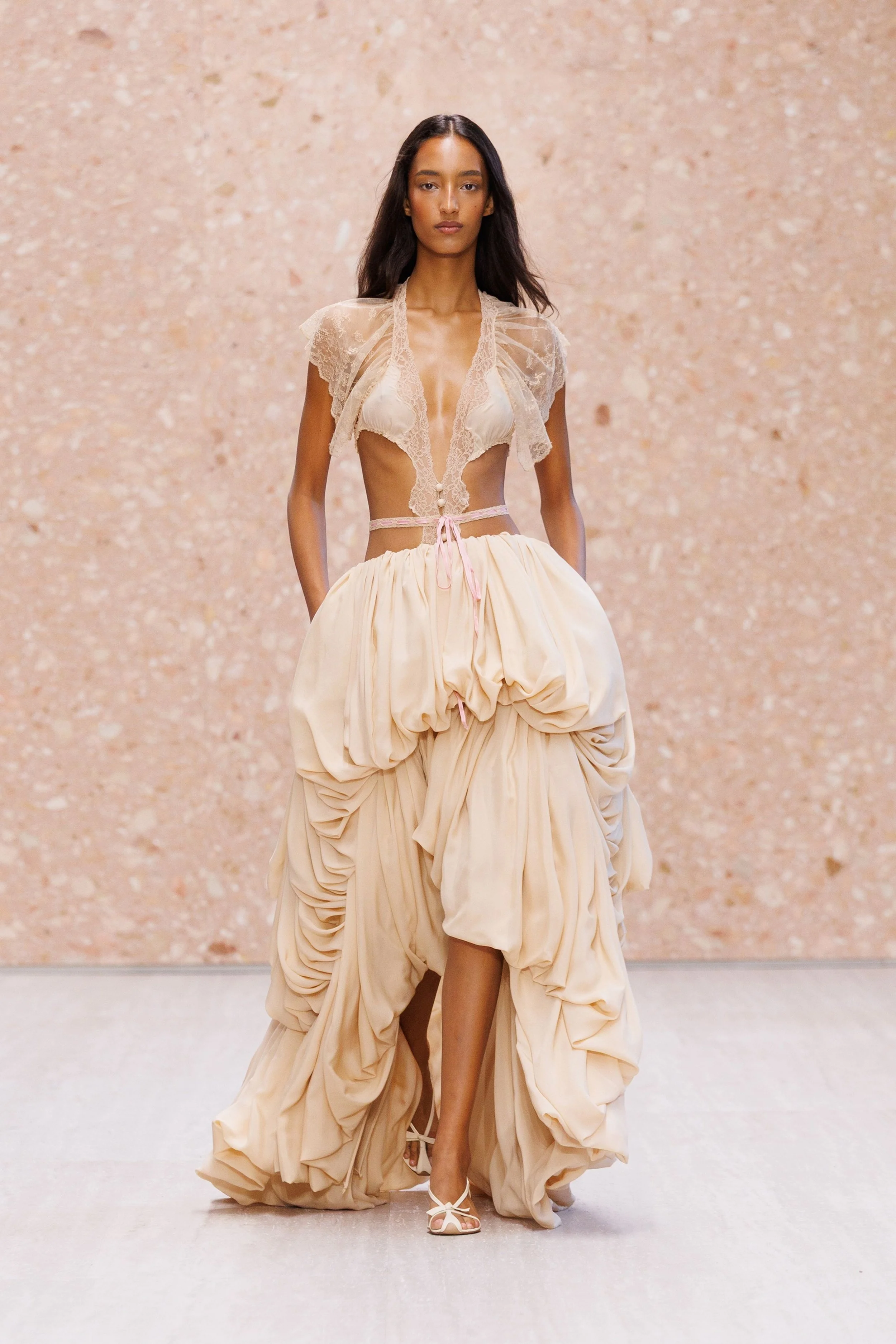
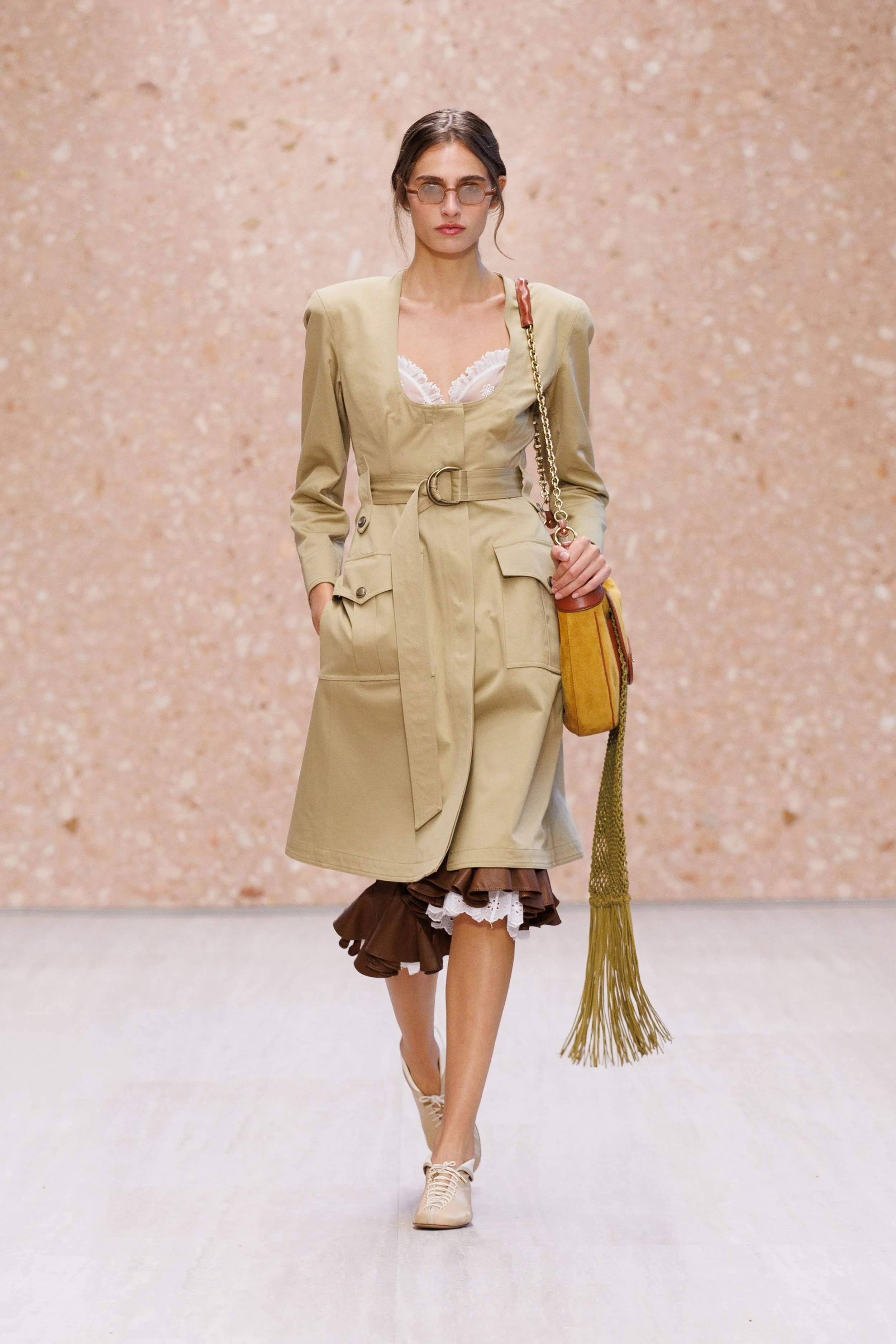
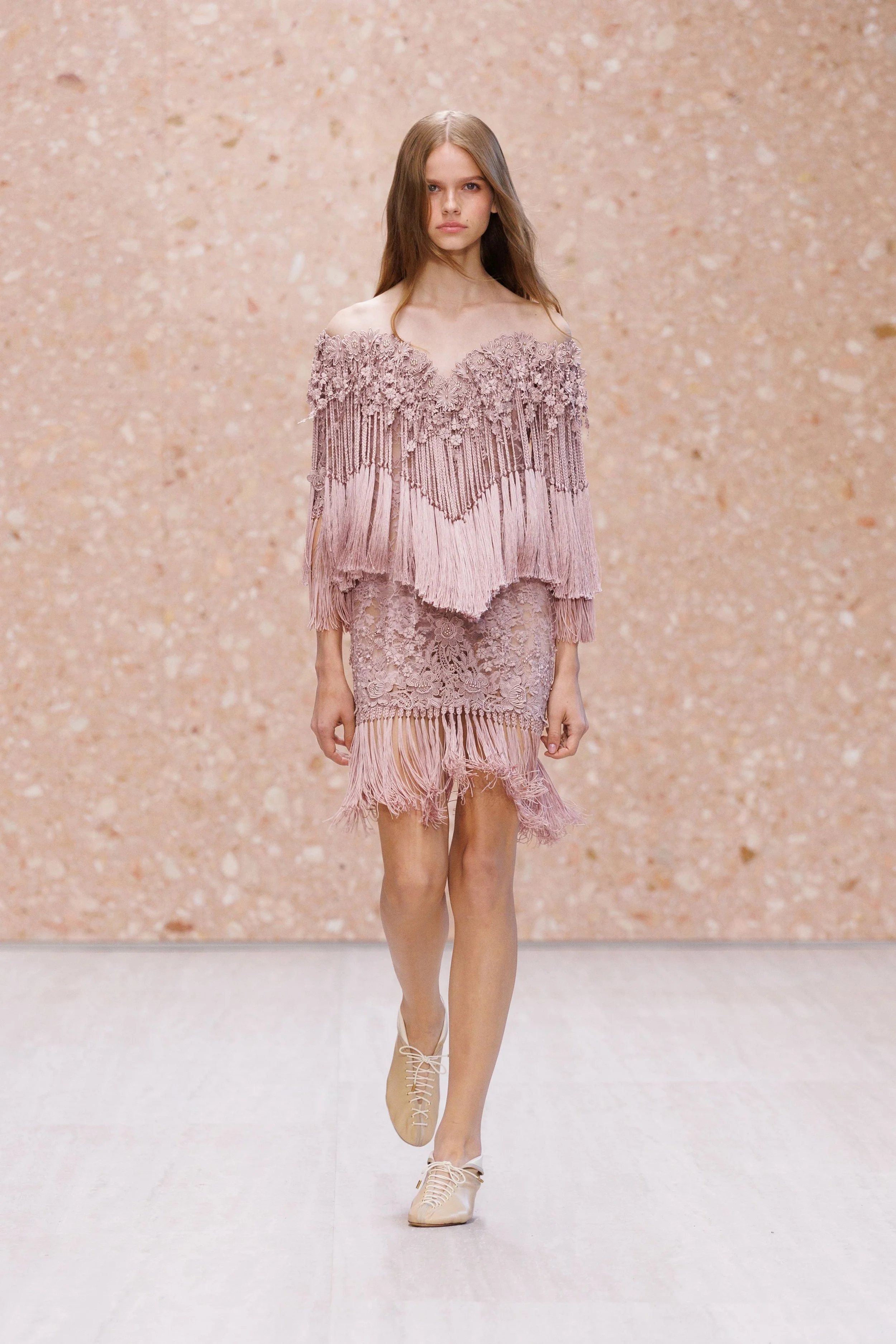
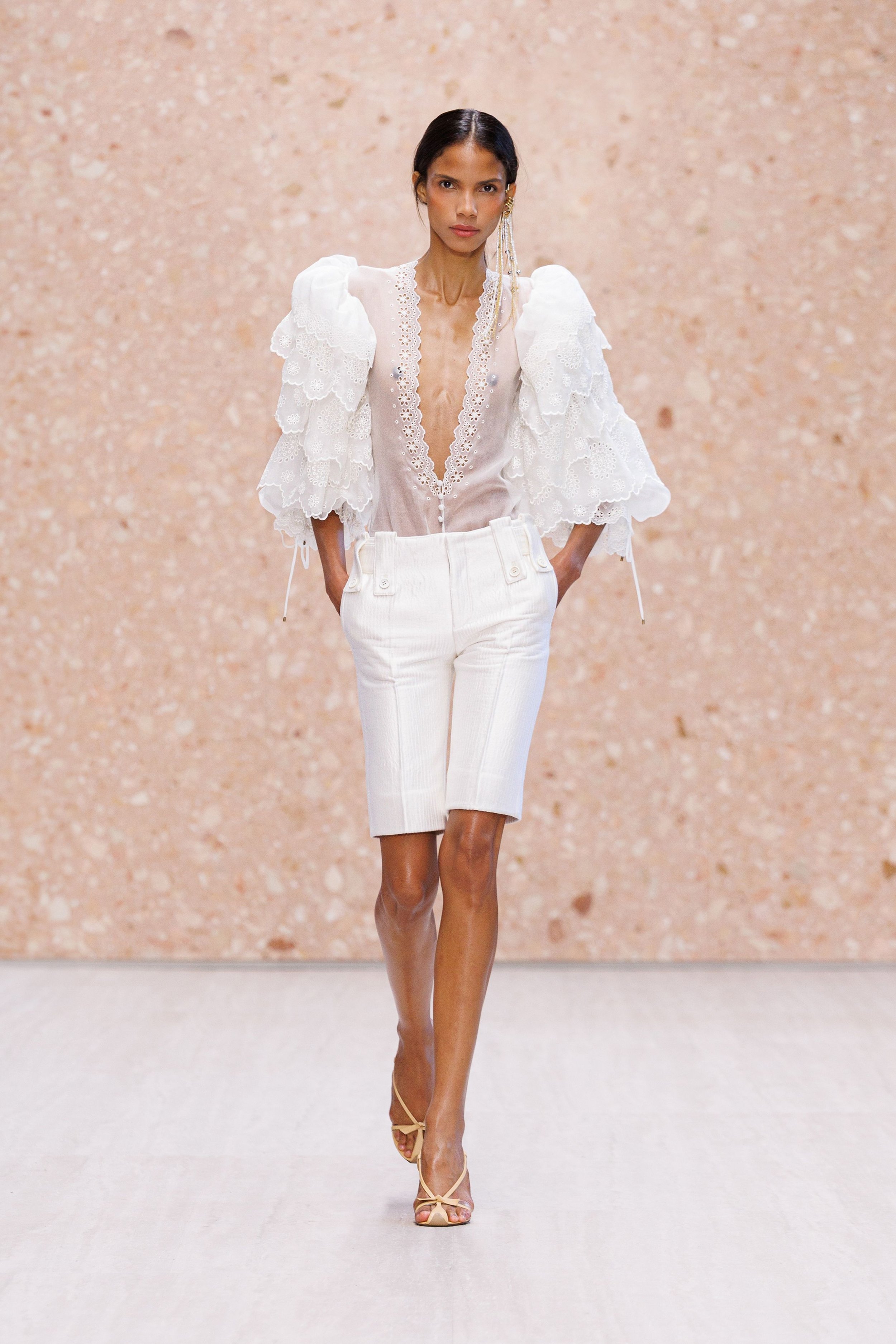
I find this work valuable, especially the way the technique is used not merely as decoration but as a means of transforming the fabric’s surface, transparency, and overall perception. Still, I would have liked to see something more innovative, something slightly more daring in the contrasts between materials. Imagine combining perforated cotton with the vinyl of the raincoats, technical fabrics, or a more unapologetic approach to tailoring. Something. That kind of experimentation could have preserved Chloé’s romantic sensibility while pushing it towards something new and modern.
In fact, the collection is not limited to the bohemian universe. The maison itself highlights the importance of tailoring and the influence of Edward Sexton, the celebrated British tailor who worked with Chloé in the late 1990s and developed a highly distinctive approach to constructing the masculine silhouette. This reference is particularly significant because it opens up a different direction for the house: garments with defined shoulders, stronger proportions, and a construction that moves away from the fluidity of dresses. WOW. Could this actually be Chloé?
For me, that balance between structure and delicacy could have been one of the collection’s strongest elements. Perhaps many fashion journalists or industry critics would argue that it means abandoning the essence of Chloé, but people would certainly be talking about it. I have no doubt that it would have generated greater impact across social media and the fashion press. It would mean giving the house a twist and seeing what happens when its romantic codes collide with more precise tailoring.
As for the colour palette, although white, black, and soft shades dominate, we also see touches of butter yellow, dusty pink, burnt orange, and mustard. The most striking contrast comes from the tomato-red and vibrant-yellow raincoats, paired with wide-brimmed hats. These pieces introduce a different kind of energy. They wake you up during the show. Suddenly, something happens, something catches your eye in a collection that might otherwise feel a little too delicate.
Tomato red is one of the colours that stands out to me the most throughout the show because it disrupts the rest of the palette. It reminds me of Andy Warhol’s Campbell’s Soup Cans, with their repetition of the same image and subtle variations.
Even so, I have mixed feelings about the colour palette. The contrast between neutrals and saturated shades works. At times, colour seems to be introduced purely to create an impact, while at others it simply complements the romantic aesthetic without really changing how we read the look or telling us anything new.
Let’s talk about the styling, because for me it is a fundamental part of any fashion show and one of the aspects I enjoy the most. The wide-brimmed hats, sunglasses, and layering are an absolute yes from me. These details help construct the house’s relaxed, bohemian image. I like the feeling that the woman wearing these clothes has dressed entirely on her own terms, without worrying about making everything look perfect. Perhaps this image feels a little less refined and more liberated than the more Parisian Chloé I have in mind, and that is precisely why it interests me.
When comparing this collection with Kamali’s previous work for Chloé, I also find quite a few similarities. Her Spring/Summer 2025 collection already featured visible lingerie, babydoll dresses, lace, and bloomers, those short, voluminous garments reminiscent of historical underwear. Here, transparency and that delicate femininity make another appearance, so even though the garments and combinations may change, I still feel we are moving within a very similar aesthetic universe. This gives the collection a sense of coherence with her previous work, although personally, I would have liked to encounter a more unexpected twist.
The show’s wider cultural impact also deserves a mention. The presentation took place on Avenue de l’Observatoire in Paris and brought together figures from the worlds of fashion, music, and cinema. Among them was Cynthia Erivo, the British actress who attended wearing a long, bohemian-style black skirt and a printed jacket in shades of purple. American actress Claire Danes was also in attendance, as was Apple Martin, who made her runway debut in a white dress, walking naturally with her hands in her pockets, as though the dress were entirely her own.
The presence of personalities from different generations helps demonstrate how Chloé can connect with a diverse audience. However, what interests me is not simply who attends, but how each person interprets the house’s aesthetic. The front row and public appearances are also part of a collection’s communication, allowing us to see how runway codes can be adapted to individual styles and extend far beyond the show itself.
Ultimately, The Obsession Collection preserves the essence of Chloé and reinforces the codes that Chemena Kamali has revived since taking over as creative director. My highlights are the brightly coloured raincoats, the craftsmanship, the jewellery transformed into a top, and the contrast between romanticism and tailoring. Still, I believe the collection needed a little more risk and that elusive wow factor that transforms a beautiful runway show into a genuine fashion moment. The collection works, but with some looks, I cannot help feeling that we have already had that moment.
Meanwhile, the industry has already started placing its own bets. Following the announcement of Anthony Vaccarello’s departure as creative director of Saint Laurent, rumours have pointed to Chemena Kamali as one of the potential candidates to replace him. Coincidence? For now, they are only rumours, but the possibility is there, and I like it.
In the meantime, let’s return to Chloé: where will the maison go with its next collection? Will it continue to embrace its romantic identity, or will it dare to break the rules a little? One thing is certain: after this collection and the rumours surrounding Kamali, expectations are building.
Words by @andreaalegriab
Translated by @alraco43