
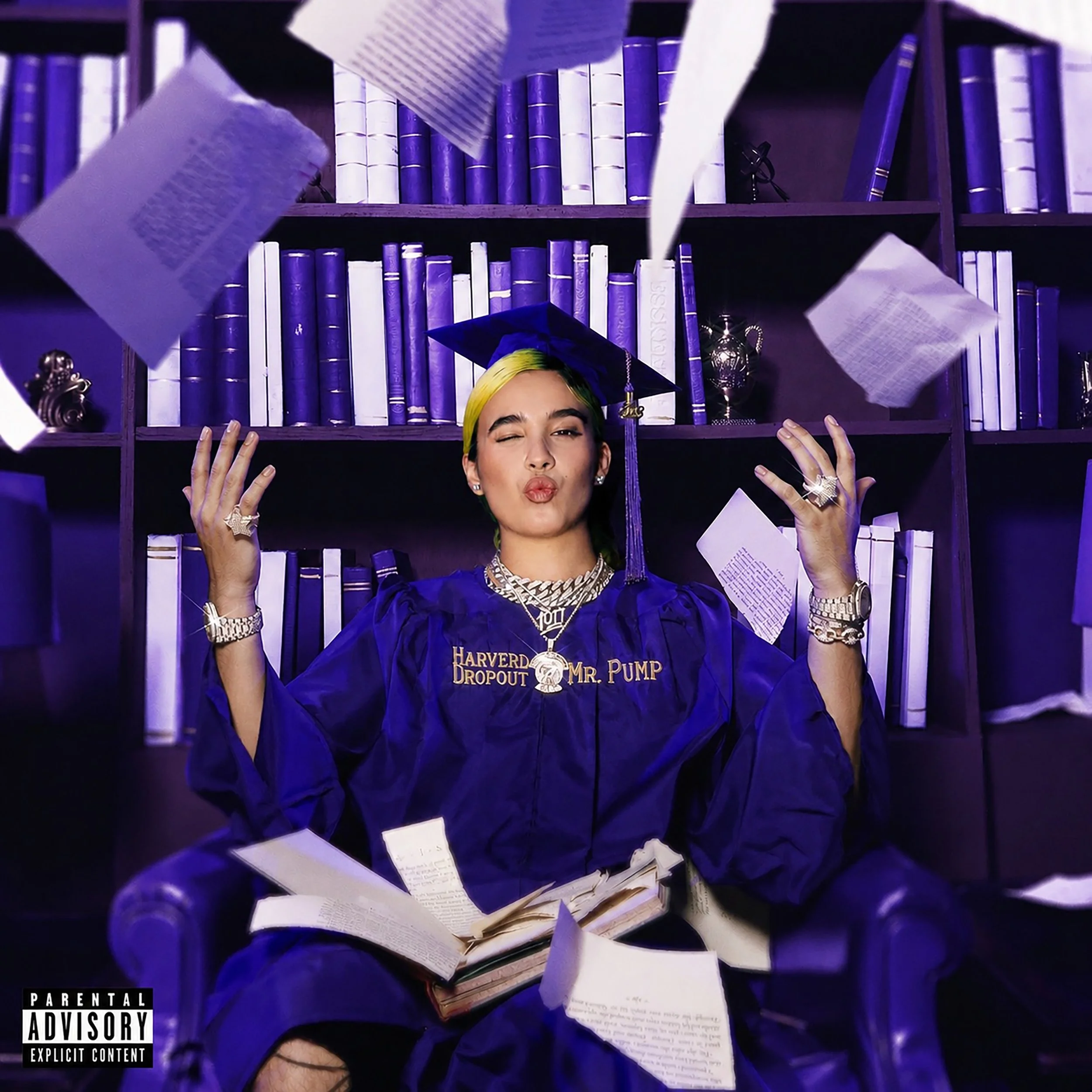
Between nostalgia for Barcelona’s trap scene, internet culture, and an identity built around extravagance, TK Mami represents a generation of artists who refuse to wait for the music industry to make room for them. With the release of TK MAMI UNIVERSITY, the artist transforms her musical influences into teachers, champions the importance of community, and reflects on the boundaries between persona and person. We spoke with her about creative freedom, digital culture, the differences between Madrid and Barcelona, and the contradictions of growing up within an industry that is still learning to question itself.
In an industry obsessed with virality, speed, and the construction of instantly recognizable personas, TK Mami seems interested in a more complex question: how to transform a personal identity into an artistic project without losing control over it. Her university offers neither an academic model nor a formula for success, but rather a way of understanding creativity through influences, relationships, and shared experiences. Perhaps that is where the most compelling paradox of her work lies: while building a persona that appears fearless, she openly acknowledges that she is still learning how to protect the person behind it. And, for now, that might be her most important lesson yet.
ÁLVARO RAMOS: To begin with, how would you describe your evolution within the music industry? Do you feel comfortable with where you are right now, or are you still trying to find your place?
TK MAMI: Right now, I’m going through a bit of a creative block. I love making music, but the whole management side of things is really overwhelming. Even when I delegate work to other people, the final decision always comes down to me. I also feel like I have a very distinctive aesthetic, something that’s very personal to me, and I find it difficult to delegate anything related to my visual or creative identity. It’s hard to find someone who understands exactly what you want to do. Between that, the album, and all the work behind it, my head is pretty overloaded. But at least the project is finished now.
AR: You’re presenting TK MAMI UNIVERSITY. What exactly are we supposed to learn at this university? Is it a celebration of your own universe or a way of mocking the rules imposed by the music industry?
TKM: The thing is, I don’t fuck with the industry. I make up my own rules, and I’m going to teach them, you know? I also think there’s an element of proving something to all those people who never believed in me. It’s like telling them, “Look where I am now.” Although I don’t really like putting it that way, because careers aren’t linear. One day you’re on top, and the next you’re not. But I am proud of how far I’ve come. When I was at school, loads of people made fun of me for making music. They were like, “What a loser, what is she even doing?” And now, suddenly, I’m doing all of this. That means a lot to me.
AR: After BIG ASS MAMI, what did you feel you needed to show with this new project? How did it all start coming together?
TKM: It happened pretty naturally. I made one track and, from there, I thought I wanted to make an album with people I liked and admired. The project actually started about a year ago. The first collaboration I did was with Kaydy Cain and El Mini, although El Mini couldn’t be part of the final project because he was also finishing his own album. For me, that was a huge moment because I’ve been making music for years, but I’ve only been properly involved in the industry for a relatively short time. For a long time, I felt really alone throughout the whole process. I saw other people surrounded by their groups of friends, their contacts, or loads of people supporting them, while I felt like I was doing everything on my own. Suddenly, having artists like Kaydy Cain or El Mini want to work with me was incredibly important. These were people I’d been listening to for years, and all of a sudden, I was making music with them.
AR: One of the most interesting things about TK Mami is how you’ve built such a recognizable visual identity. The neon colors, the long nails, the hyperfemininity contrasted with a much more aggressive way of rapping… Where does all of that imagery come from?
TKM: I think I’ve always been pretty extravagant. I’ve gone through phases where I was much more indie, more minimalist, both in my music and in the way I dressed. But even within those scenes, I was always kind of the weird one, you know? About two years ago, I discovered a side of myself that I didn’t even know existed. And it happened through music. I realized I had the attitude to do whatever the fuck I wanted and get whatever I wanted, just like that. I used to be extremely shy. I held myself back a lot, and I felt this huge frustration because I knew there was something inside me that I wasn’t showing. Making music helped me lose that fear, and I discovered that I actually had a lot of attitude. I think that whole transformation eventually came through in my aesthetic: the colorful hair, the nails, the clothes, all the extravagance. It’s as if everything I’d always had inside me finally found its way out.
AR: Your music constantly moves between provocation, irony, and humor. How much of what you say is spontaneous, and how much comes from an awareness of the impact your lyrics might have?
TKM: That happens to me all the time. I’m making music, and I just say whatever comes into my head without thinking too much about it. But that’s also because I spent so many years repressing myself and not saying things out of fear of showing who I really was. What I’ve learned over the last couple of years is to stop being afraid of that. Sometimes it gets me into trouble, too, because I’ll say something without any bad intentions and then have to deal with the consequences. Suddenly, I’ll think, “Fuck, I said this, and maybe someone’s going to take it the wrong way.” But I’m not saying it as an insult or because I want to hurt anyone. It’s just what came out at that moment. And that’s it.
AR: If you had to choose one song from TK MAMI UNIVERSITY that represents who you are right now, which one would it be?
TKM: There’s a track I really love because I feel like it has a special sound, but I think the song that represents me the most right now is “Buenos Modales,” with Goa. I’m going through a bit of a low moment. I think too many emotions have piled up with everything surrounding the album, and now I feel like I’m experiencing some kind of emotional comedown. It’s all been really intense.
AR: Do you think our generation uses humor as a tool for freedom, or as an excuse not to take anything too seriously?
TKM: One hundred percent. Although I also think it’s a pretty controversial subject. Some people hide behind the idea that something is “just humor” to hurt others, make racist jokes, or say things that actually come from a place of bad intentions. But in my case, I think humor has been a way of liberating myself. For a long time, when I started showing certain sides of my personality, I labeled everything as humor. It was a way of justifying what I was doing because I was still holding myself back. Until I realized it wasn’t humor, that I’m just like this. I’m also a funny person. So if someone wants to call my music humorous because they find it funny, that’s fine. But to me, it isn’t necessarily a joke. It’s just how I express myself.
AR: There’s something very generational about your music, particularly in the way you use references, memes, and codes that seem to belong to very specific communities. Do you think that, to fully understand TK Mami, you need to share a certain kind of internet culture?
TKM: Yes, totally. For example, some of my mum’s friends listen to my music, and I realize there are so many references they just don’t understand. At the end of the day, I rap about what I experience and the things that happen to me. And the internet is a huge part of my life. I’m surrounded by social media all day, so naturally, it constantly finds its way into my songs. But it’s not just internet culture. I also talk a lot about the streets and use codes that come from that world. I even have songs with references that literally nobody except my friends can understand, because they’re expressions we’ve invented among ourselves.
AR: That’s interesting because, rather than making music to build a community, it seems like you make music from within a community that already exists. Your songs almost function as an archive of shared experiences and language.
TKM: Exactly, one hundred percent. That’s precisely it. There are things that only make sense to the people who experienced them with me. And I don’t necessarily need everyone else to understand them.
AR: In TK MAMI UNIVERSITY, you revisit sounds and codes from the trap scene of a decade ago, particularly from that period in Barcelona when PXXR GVNG and an entire generation of artists were transforming urban music. What does it mean to revisit that moment from where you stand today?
TKM: It’s crazy to me because I feel like this album brings everything full circle. My mum used to play PXXR GVNG when I was ten or eleven. I used to go to MACBA from a really young age because I skateboarded, and I would see all those people hanging around there. I was really young, but in a way, I was experiencing everything that was happening in Barcelona at that time. I remember listening to that music with my mum and thinking, “Wow, I want to sound like these people.” They were my references. And I never would have imagined that I’d end up making songs with them. Now, all of a sudden, I’m collaborating with artists I listened to when I was a kid. It’s overwhelming because a lot of the time you’re not even aware of your own journey. From the outside, people can see how you’ve evolved, but when you’re living it, you’re so caught up in everything that you don’t have that perspective. With this album, I’ve actually been able to look back and think, “Fuck, look where I am now.”
AR: In a way, you’ve managed to turn your nostalgia into your present.
TKM: Yes, totally. And that’s exactly one of the things I wanted to communicate with this album. The collaborations weren’t chosen randomly. I deliberately brought these people together because they’re part of my story. That’s also why I loved the concept of TK MAMI UNIVERSITY so much. It’s as if I’m graduating and all the artists featured on the project are my professors. And in a way, they really have been. I grew up listening to them and learning from their music.
AR: The project also allows us to explore the differences between Spain’s various music scenes. Do you think there’s still a recognizable distinction between what comes out of Barcelona and what comes out of Madrid?
TKM: Yes, absolutely. I think Barcelona has always had a scene much more connected to trap, much more niche, more outsider. Everything was a lot more underground. Madrid, on the other hand, has always had a much stronger rap tradition, something more purist. And you can hear that in the way people make music. Loads of rappers have come out of Madrid, and Barcelona has its own rappers too, obviously, but I think people rapped differently there, with a different kind of style. To me, Barcelona has historically been a much more cosmopolitan city, where there’s been a huge amount of cultural mixing. Part of that also comes from its history, the 1992 Olympics, cultural spaces like Apolo… I feel like Barcelona has been a pioneer in a lot of things. Madrid also has a lot of cultural diversity, but I think for a long time it was more concentrated in the outskirts. Plus, Madrid is enormous, with so many neighborhoods and surrounding towns. Barcelona is much more compact, which meant everyone ended up hanging out in the same places. I think that closeness also created a very particular scene, where different people and styles naturally came together.
AR: Your project has a provocative dimension that seems to generate very polarized reactions. Is there a risk of eventually making music for your haters rather than for yourself?
TKM: I swear, I feel like my persona generates so much hate. I know that when you start growing as an artist, having haters is normal, but I feel like in my case it’s completely exaggerated. There are people who genuinely hate me, and honestly, I don’t understand why. I’m not constantly causing drama on social media, insulting people, or going after anyone. Obviously, I’ve made mistakes, like everybody else, but I don’t consider myself a problematic or confrontational person. And the people who actually know me know that I’m super chill. TK Mami is partly a character. I don’t go around talking like that in my everyday life or behaving that way all the time. Sometimes I see other artists doing much more controversial things, and they don’t get anywhere near the same level of hate. I think what bothers a lot of people is that I genuinely don’t care what they think. It’s almost as if it annoys them that a girl can do whatever she wants without worrying so much about other people’s opinions.
AR: Your artistic language is deeply connected to digital culture, but that same culture operates through algorithms that decide what gets visibility and what doesn’t. To what extent do you feel the algorithm plays a role in your creative process?
TKM: A lot. For me, TikTok is an incredible gateway for people to discover my music. And Twitter is essential too. Actually, loads of times when I’m about to write something, I’ll go on Twitter. I’ll come across a thread, a conversation, or some random stupid thing, and suddenly it inspires me to talk about something in a song. But I also feel like there’s quite a lot of censorship surrounding my persona on social media. At the end of the day, my music and my aesthetic are provocative, and I often touch on subjects that don’t work well with the algorithm. So I notice that certain types of content get penalized or receive less visibility. It’s a bit contradictory because social media is an essential tool for getting my music out there, but at the same time, I feel like it limits some of the things I want to express.
AR: There certainly didn’t seem to be many limits during your performance at Riverland. You packed out the tent and put together a show featuring visuals, an inflatable installation, and different stage elements. What was the process of creating that live performance like?
TKM: It was pretty complicated, and honestly, everything came together in a very improvised way. The team I’m working with now is fairly new. When I was confirmed for Riverland, I was practically managing my entire project on my own. I knew I had that show coming up, but I didn’t have the resources or the team needed to create the performance I actually wanted. The fee I was getting at the time barely covered anything. I ended up breaking even, or actually losing money, just to try to put together something decent. I spent loads on the inflatable, paying Aft3rlife, who’s my producer and DJs for me, and putting together the visuals. There was another problem, too: I hadn’t released a cohesive project yet. Everything was singles, and every song belonged to a completely different universe. Conceptually, it was really difficult to create a show with one clear narrative. Now, with the album, I think that will be much easier because there’s already a concept that can be translated into a live performance.
AR: In an industry that often measures success through streams and numbers, you seem to place much greater value on staging and performance. Do you think the live show is being neglected as a form of artistic expression?
TKM: Totally. For me, live shows are an incredibly important part of being an artist, and I think doing them well is really difficult. You go to huge festivals like Primavera Sound and see artists who are massively successful but have terrible live shows. And a lot of the time it’s because they don’t want to invest money in that. They’d rather spend it on something else. Which is fine, everyone makes their own decisions, but personally, it really puts me off. Riverland was a really important opportunity for me, and I would have loved to put on an incredible show. I think it’s one of the most important festivals for artists of our generation. If I go back, I want to offer something much more developed and show people that I’m capable of doing so much more. But I also understand that everything takes time and that putting on a good show depends on loads of different factors, especially budget.
AR: Beyond the performances, Riverland also seems to function as a meeting point for a scene that grew through the internet but still needs physical spaces where people can recognize themselves as part of something. How important are these festivals for your generation?
TKM: Riverland has something really special about it. First of all, even if you’re a new artist and don’t have a huge audience yet, people will still come to see you. That doesn’t happen at every festival. There are so many people willing to discover new music, and that’s amazing. You also have access to visual resources, screens, and technical possibilities that aren’t always available elsewhere. And then there’s the social side. I’ve performed at other festivals where you arrive backstage, every artist is locked away in their dressing room, and nobody talks to anyone. Riverland is completely different. Everyone runs into each other, talks, meets new people… It’s a festival where artists at very different stages of their careers coexist, but everyone is part of the same scene. I think that’s really beautiful because it creates a real community beyond social media.
AR: Let’s go back to TK MAMI UNIVERSITY. If you had to fail the Spanish music industry in one subject at your university, which one would it be?
TKM: Philosophy. One hundred percent.
AR: Why philosophy?
TKM: Because I think people need to think a little more. I don’t know, I feel like a lot of the time people don’t really question things enough.
AR: And which subject do you think you still need to pass? What’s the biggest lesson you’re currently learning within the industry?
TKM: To stop being so naive. One hundred percent. At the end of the day, I’ve just turned 21, and I’m constantly working with people who are 40, 50, or 60 years old. These are people who’ve been in the industry for years, who have much more experience and know exactly how everything works. I’m still learning. And you can really feel that difference in age and experience. Sometimes people take advantage of me because I’m more naive or because I haven’t developed the same thick skin that they have. I think that’s one of the biggest things I still need to learn: how to navigate the industry better without losing who I am.
AR: Finally, if someone who’s just starting to make music wanted to enroll at TK MAMI UNIVERSITY, what advice would you give them? What’s the most important thing you’ve learned about building your own artistic identity?
TKM: I think what’s helped me the most with my project, and what’s also made me feel the most satisfied with it, is committing to my own vision. If you have a clear idea of what you want to do, you have to follow it. I also think attitude is incredibly important. Without attitude, it’s really hard to get anywhere. It’s happened to me before that, because I was shy, someone else would come along with so much more confidence and completely overshadow me. And I’d be left thinking, “Fuck, why didn’t I do that?” But above all, I think you have to be a genuine, authentic person. That’s something that’s really missing these days. Have your own identity, believe in what you do, and treat people well. To me, those are the most important things.
Questions by @alraco43