
MINOTAUR BY ANDREY ZVAGINTSEV (SSIF’26): THE VIOLENCE BENEATH A PERFECT SURFACE
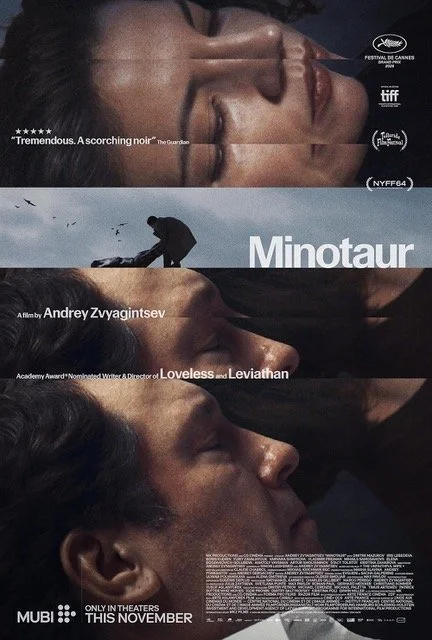
Andrey Zvyagintsev returns to cinema with ‘Minotaur’, a cold and meticulously controlled drama. Based on Claude Chabrol’s ‘The Unfaithful Wife’ (1969), the film follows Gleb, the wealthy head of a successful transportation company, whose carefully ordered existence begins to collapse when he suspects that his wife, Galina, is having an affair. At the same time, he is forced to provide the names of fourteen of his employees to be drafted into the Russian war. Two seemingly separate crises gradually begin to reveal themselves as part of the same story.
Zvyagintsev has always been interested in the violence hiding beneath apparently stable lives, and ‘Minotaur’ may be one of his most precise explorations of that idea. Gleb's company functions with the efficiency of a machine; his marriage, too, seems to operate according to an established system of gestures and routines. Yet there is something deeply empty inside it. The more perfect the surface becomes, the more obvious it is that something underneath is already beginning to crack.
Mikhail Krichman’s cinematography is fundamental to this sensation. His camera moves through these spaces with an almost clinical precision, observing rather than comforting. Faces, rooms and bodies become part of the same carefully composed architecture. Interestingly, Galina is often denied the visual centrality that we would expect from a character whose suspected infidelity drives so much of the plot. For much of the first act, she remains slightly outside the frame, as if she were another element of Gleb’s life that he believes he can control. But Galina is tired of existing in his shadow.
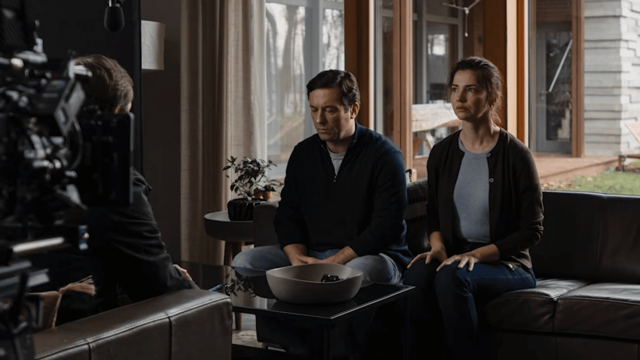
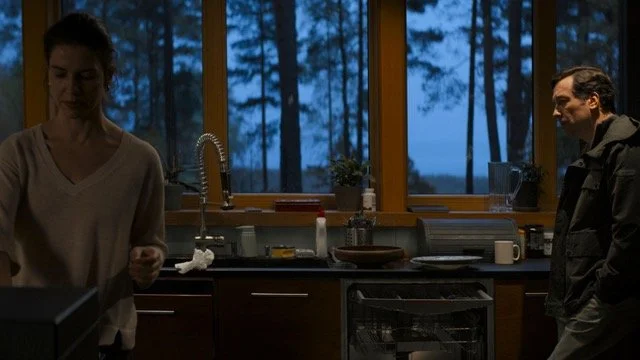
The title is particularly revealing. The Minotaur is not only a monster waiting at the centre of a labyrinth. The labyrinth here is a social and political system in which every attempt to maintain control leads deeper into the maze.
Its political dimension is inseparable from its intimate one. The war outside Gleb’s home and the crisis inside it begin to mirror each other. The same mechanisms of possession and control that govern his marriage also operate in his professional life. Yet ‘Minotaur’ never feels like a political thesis disguised as a film. Zvyagintsev trusts images and gestures to carry much of its meaning. His characters are constantly watching one another, measuring one another, trying to understand what has changed...
This movie can feel calculated in its compositions and deliberately restrained in its performances, but underneath that control are jealousy, desire and violence. That contradiction gives ‘Minotaur’ much of its force. It is a film obsessed with order that constantly threatens to become chaos. Also, it makes one of the most unexpected uses of an Anohni song imaginable, turning the needle drop into something far more emotionally destabilising than a conventional soundtrack cue.
Zvyagintsev’s return is therefore not simply a reinterpretation of Chabrol. ‘Minotaur’ takes the structure of a classic marital drama and exposes the political violence already contained within its ideas of ownership, hierarchy and control.
Words by @joaquinxbc