
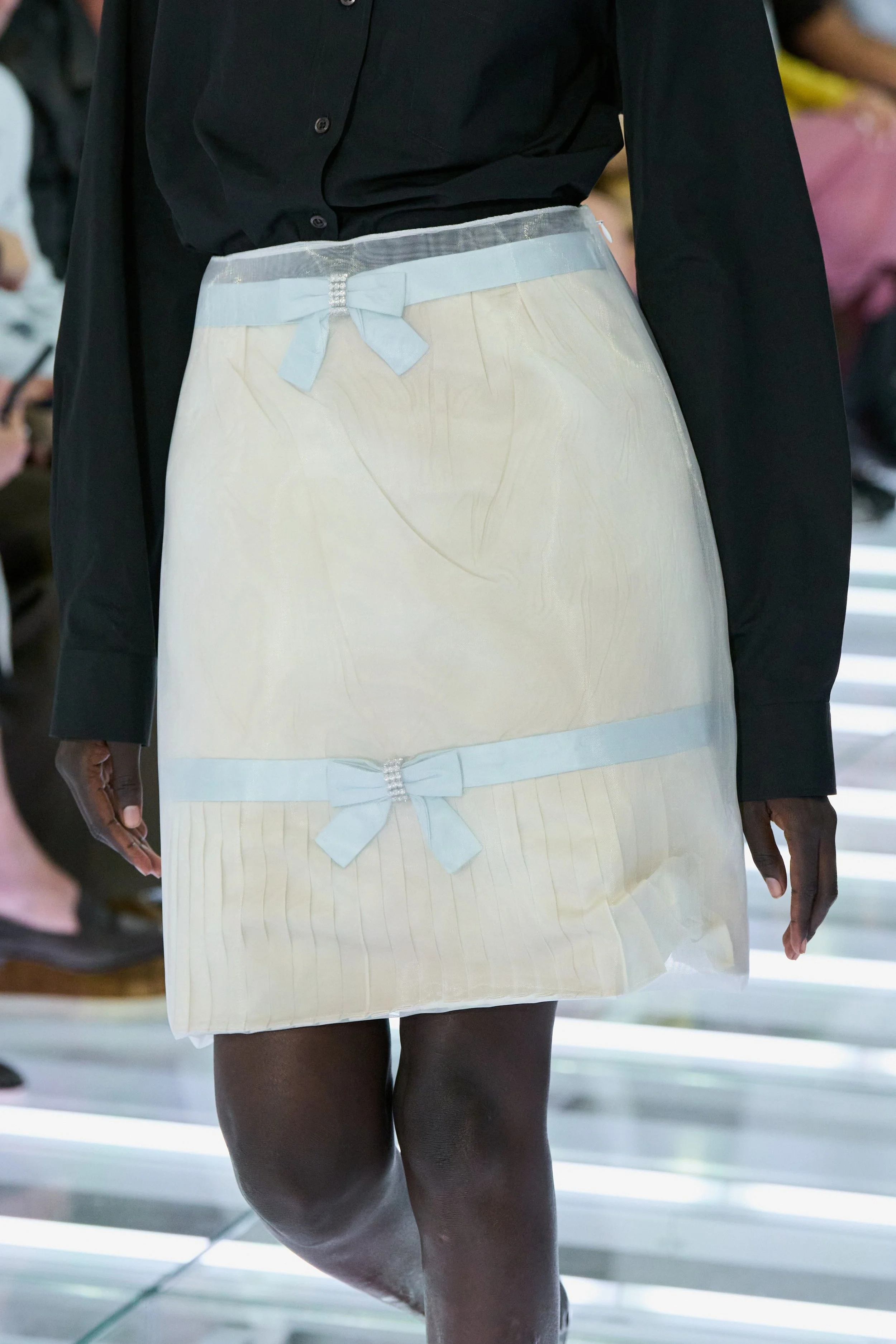
Miuccia Prada and Raf Simons present The Skirt, Prada’s Spring/Summer 2027 collection, consisting of 63 looks, all featuring skirts. Every kind of skirt is explored, and not a single pair of trousers makes an appearance. The designers place the skirt at the centre of the collection, treating it as an object in its own right. The skirt is an obsession for Prada, and the aim is to preserve the language communicated through this particular garment. They examine it through variations, looking at it from different angles and exploring its different forms of expression. They take this garment and turn it into the focal point of the entire collection.
During a famous interview in 2006, Miuccia made the following statement: “Skirts are like T-shirts.” Today, she continues to stand by this idea, demonstrating that a skirt can be an incredibly versatile garment and the starting point for an everyday outfit that requires little to no thought.
Historically, the skirt has been one of the earliest garment typologies, and its meaning has never been fixed. It has constantly evolved depending on its social and cultural context. Miuccia and Raf seek to free the skirt from its historical and social weight, transforming it into an everyday basic that can be worn just like a T-shirt.
The show took place on 22 September 2026 at the Deposito of Fondazione Prada, located in Milan, Italy. This venue has become a familiar setting for the brand’s runway shows in recent years.
The opening look features a red midi skirt falling just below the knees, with a Velcro fastening that slightly disrupts the garment’s construction. On top, the model wears a lace top resembling a corset. The makeup, hairstyle and overall styling are extremely minimal, leaving no visual distractions and directing all our attention towards the construction of the skirt. From the very first look, Prada shows us how easily this garment can be paired with a second-skin piece such as a top, demonstrating that a skirt can become part of an everyday uniform.
Prada makes it clear that the skirt is not simply an accessory or an additional element, but the foundation of the entire outfit. We see the garment in different lengths, from mini skirts to knee-length and midi styles. On top, the models mostly wear basic, minimalist pieces such as leather jackets, lace tops, bandeau-style tops featuring graphic prints that resemble doodles, sweaters, knitted vests, shirts and T-shirts, both in neutral colours and printed versions.
Throughout the entire show, every look is built around a skirt, turning it into the essential garment of the outfit and demonstrating that we don’t need extravagant or elegant pieces to style it. Prada shows how the meaning of a skirt can be transformed depending on the simple garments it is paired with. The skirt becomes the fundamental piece from which the entire styling develops. In most of the looks, however, we see a maximalist approach to the garment.
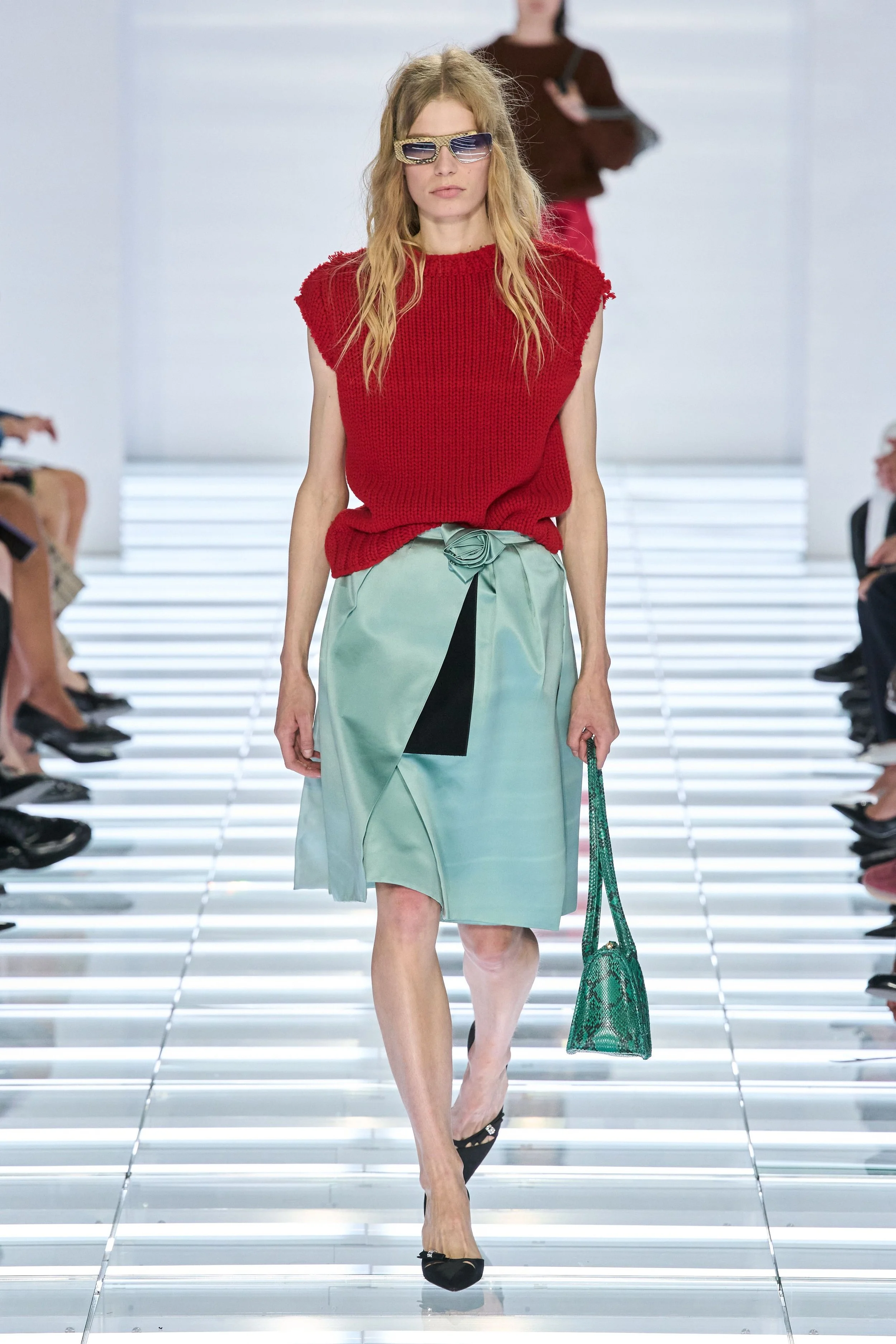
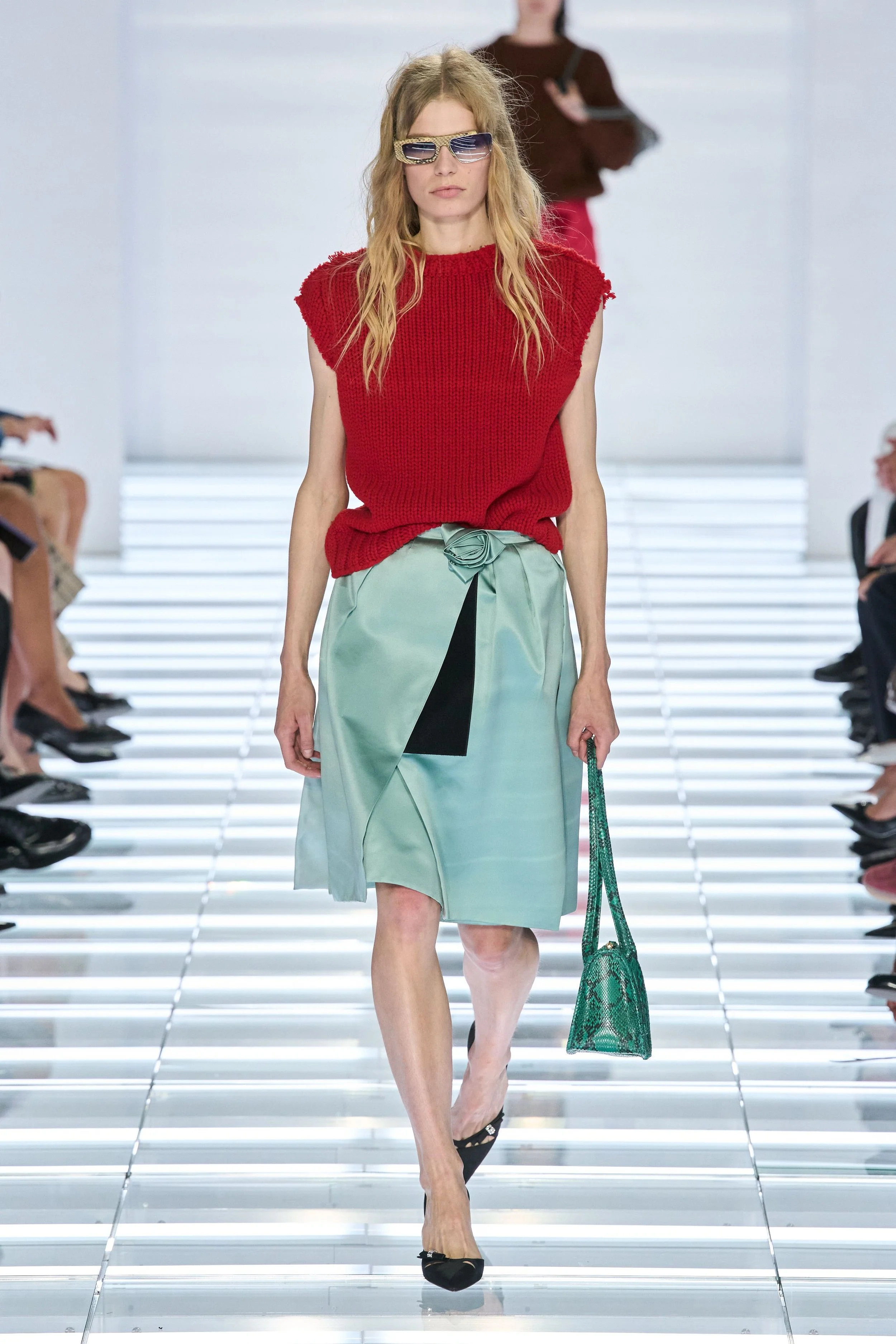
Miuccia and Raf direct all our attention towards this particular typology, experimenting with textiles, colours and techniques that challenge the way we perceive materials. Throughout the collection, we see a colour palette dominated by reds, greens and yellows. Some skirts feature oversized Velcro fastenings, deliberately presented in contrasting colours. These Velcro details are further embellished with embroidered stones and crystals. We also see pleated or accordion-style latex skirts, some of them slightly transparent, revealing the lower sections of the checked shirts tucked underneath.
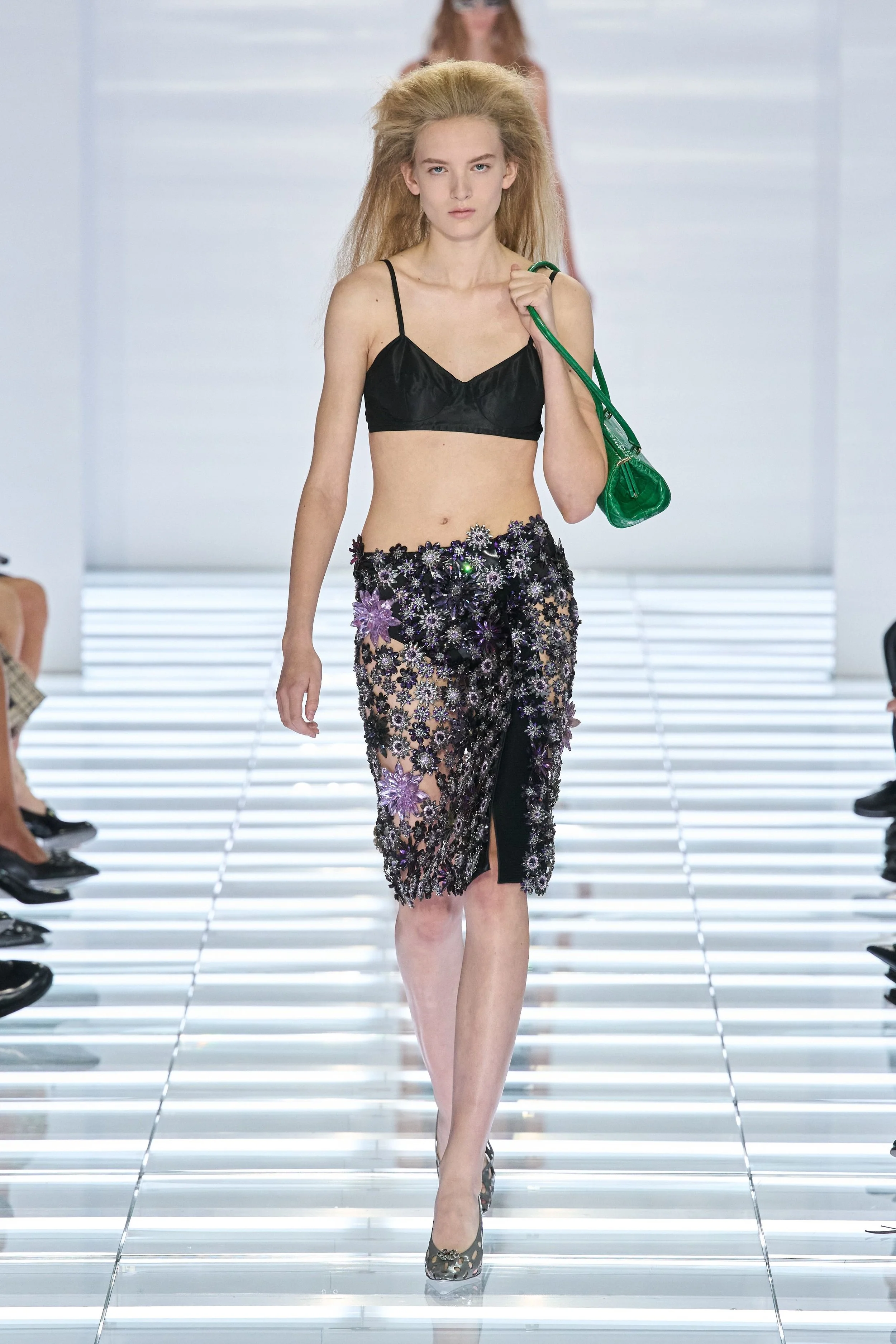
Although minimalism is a recurring element throughout the collection, Prada also plays with contrasts through maximalist designs that catch our attention with their visual effects. Some skirts appear to be “wrapped” in a sheer, blurred textile, perhaps organza or tulle, creating the impression that the garment is still covered in its original packaging, almost as if it were being preserved in a museum. Other skirts reveal the garments worn underneath as the models move.
Pieces featuring lace and crystals stand out, alongside others with experimental pattern-making and crossed structures, slits and unfinished seams. We see raw hems without turned-up edges and waistbands without conventional finishing, with exposed seams left deliberately unfinished. Prada also incorporates an internal structure, resembling a crinoline, but this time places it on the outside of certain skirts. It becomes a visible layer that almost “encapsulates” the garment, reversing the function traditionally assigned to this structure. Through these layers, details such as bows and belts underneath the crinoline remain visible.
In keeping with the spring season, floral prints featuring roses, daisies and leaves also play an important role. They appear not only as printed motifs on skirts, but also as embroidered flowers and leaves made from stones and crystals. Floral elements can also be found on tops and shoes. In addition, the collection features abstract, maximalist prints resembling colourful brushstrokes and doodles, as well as jackets that imitate hand-drawn outlines. Cotton fabrics are also used to convincingly imitate leather and suede, demonstrating the designers’ ongoing interest in transforming and reimagining familiar textiles.
Some looks feature layered garments on top, paired with skirts incorporating different textures and draping techniques. One particular skirt appears to have excess fabric falling from it, almost as if it were an unfinished draping detail, which the models hold and carry in their hands as they walk.
In terms of makeup and hair, the styling remains minimal throughout most of the collection. The asymmetrical sunglasses are particularly striking, introducing a combination of classic and futuristic elements. We had already seen this concept explored in Prada’s menswear show for the same season, creating a connection between the brand’s menswear and womenswear collections and allowing ideas to move between both lines.
The footwear consists mainly of shoes and sandals, some embellished with crystals and flowers. These designs help maintain a visual balance, ensuring that the skirt always remains the centre of attention.
When it comes to beauty, the makeup is almost imperceptible. On Prada’s website, the brand explains that the aim was to achieve a fresh, even and luminous complexion, defined by a soft and completely natural finish. Only subtle touches of colour are used to enhance the cheeks, while matte pink lips complete the look without overwhelming the face.
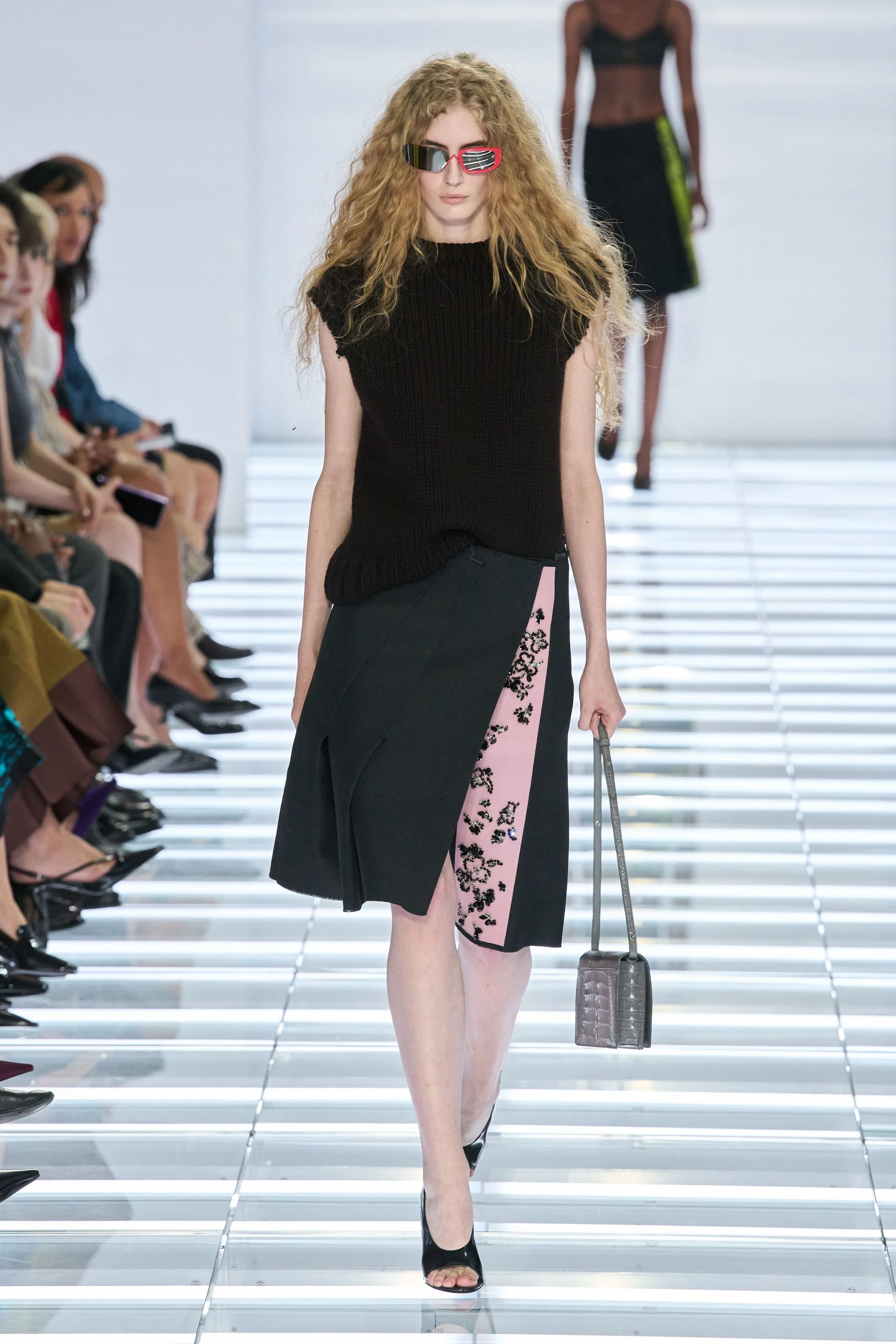
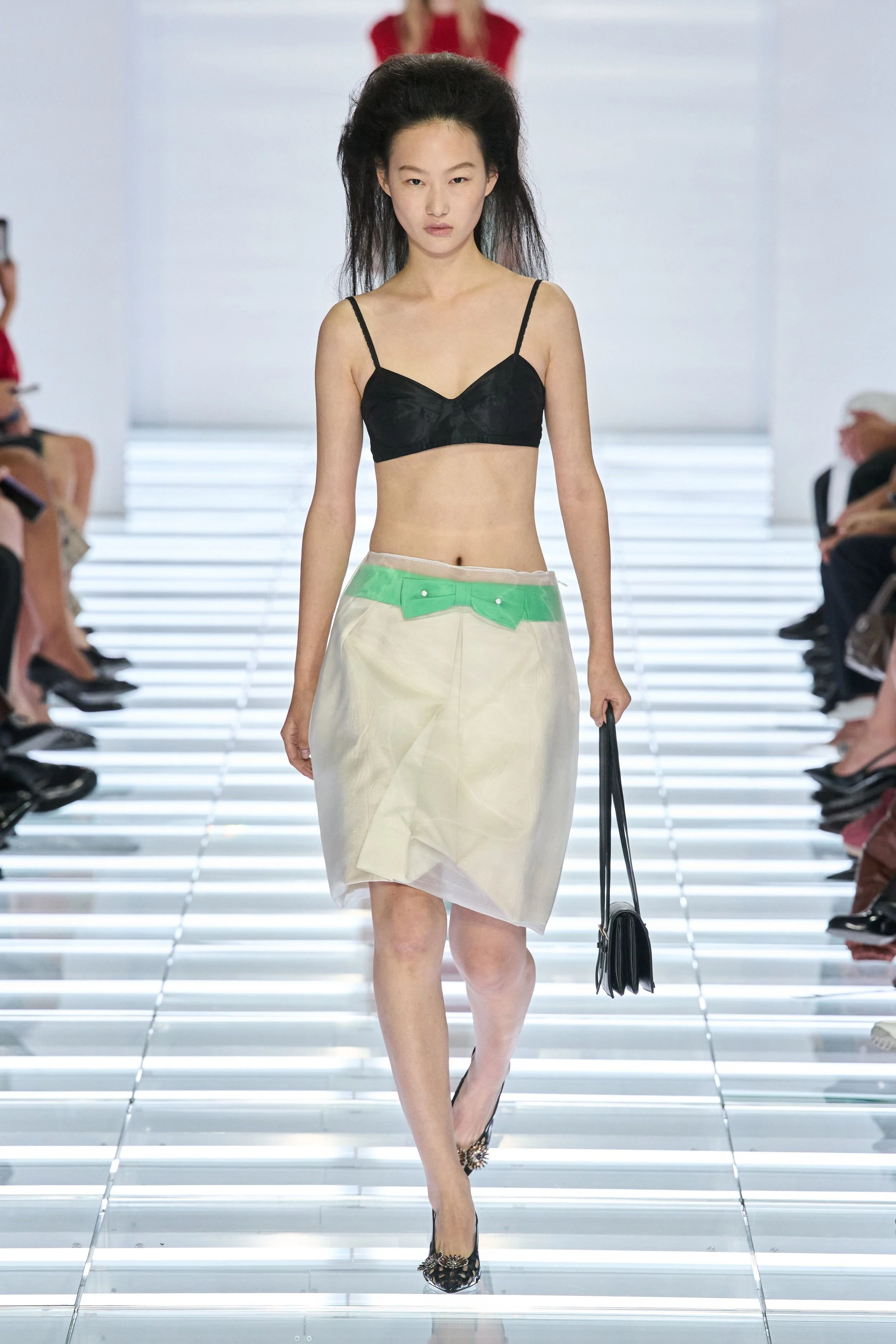
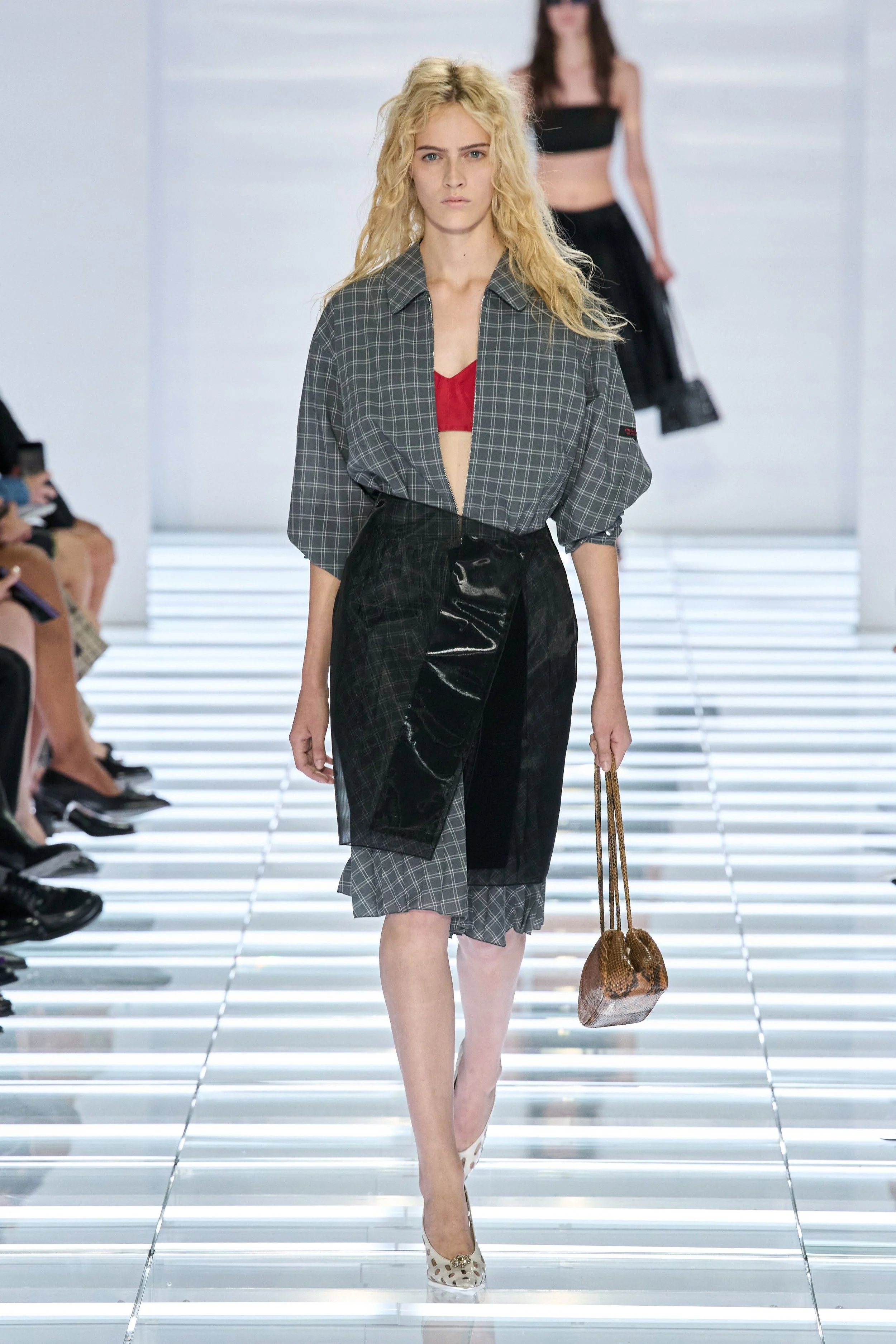
Complementing this minimalist makeup is the models’ deliberately messy hair. They almost look as though they haven’t finished getting ready, as if they had walked out halfway through a hairstyling session or simply didn’t care too much about their hair. Their clothes and attitude are enough to make them look cool. In my opinion, this natural, slightly dishevelled appearance conveys a particular message: we are looking at a busy, practical woman. Prada shows that there is no need to place so much importance on achieving perfect hair or makeup when the clothes and attitude already give the styling so much strength. They are enough on their own to make someone look good.
We also got a look at Prada’s new bags during the show. Interestingly, some of the camera shots in the runway video were specifically dedicated to capturing these accessories. What stood out the most was the colour palette: green, red and yellow in some designs, alongside more neutral shades such as black and grey. Some bags featured snakeskin prints, and most of them had long handles.
One detail I found particularly interesting appeared towards the end of the show, when the final looks introduced a series of bra-like tops. This demonstrated that Prada is also exploring the use of second-skin garments and underwear as part of an outfit that a woman could wear out on the street. These bra-like pieces also incorporated a small coin purse or miniature bag attached to the top, leaving the hands free.
The soundtrack for the show was provided by French DJ and producer Clara 3000. After reading the comments under the runway video and several social media posts, I noticed that many people recognised the track “Madam Butterfly”, which is exactly the same piece of music John Galliano used to open his famous Dior show in 2007. I found this particularly interesting because the two shows used the track in completely different contexts. Towards the end of Prada’s show, the music and soundscape undergo a complete shift, creating a more industrial and contemporary atmosphere.
To conclude, during that interview, Miuccia said that, for her, a skirt is like a T-shirt. Today, I believe she is still pursuing that same message, trying to move away from the historical and social context attached to the skirt by placing it at the centre of the collection and showing that it doesn’t have to be reserved for particular occasions or situations. Instead, it can be worn at any time and in any context.
Prada says that its obsession is the skirt, and this collection proves it. The brand delivers a message of “less is more” by repeating the same garment typology throughout all 63 looks. The intention isn’t necessarily to create a new trend around the skirt, but rather to transform its meaning and use it as a form of expression.
Words by @enzzoesteban
Translated by @alraco43