
MALAMAÑOSO SPEAKS ABOUT THE WORLD OF MIRANDO AL SUR
Between shows at MBFW Madrid, over burrata and pasta al pesto at an Italian restaurant, Francesco (the musician behind Malamañoso) talks about movement almost as much as he talks about music. From Taranto to Milan, from Europe to Latin America and now toward Madrid, his story is one of leaving, absorbing and returning: taking the rock, jazz and funk he grew up with and placing them in conversation with salsa, candombe, Afro-Cuban rhythms and the cultures he encountered along the way. His new album, Mirando al Sur, turns that journey into both a musical language and a personal map, one that questions where home begins, who gets to claim a tradition, and what happens when identity is allowed to exist between places rather than choosing just one.
Álvaro Ramos: Before we talk about the album, how would you define Francesco in 2026, both artistically and personally?
Malamañoso: I started playing drums when I was 14, in Taranto. At first I was very much into rock, Led Zeppelin and that whole world, but art had always been present in my family. My parents had a dance school and, in 1982, they became Italian champions in acrobatic rock and roll. So dance, music and that kind of energy were always there. Then I studied rock, jazz, Latin music… I was always curious about music in a 360-degree sense. The problem was that I came from a small city in southern Italy, and I felt that if I wanted to move forward, I had to leave. One of my friends kept telling me, “You have to get out of Taranto.” And eventually I did. I moved to Milan in 2014 thinking more about dance than music. I joined an academy and for a while I tried to pursue both at the same time, until one of my teachers told me, “You have to choose: dance or music.” I didn’t even have to think about it. It was music. The Francesco of ten years ago wanted to do everything. The Francesco of today knows what he wants. I know what I want to do with Malamañoso, I know where I want to go, and I have a vision. That vision didn’t appear overnight. I had to work hard to find it.
AR: And what exactly is that vision?
M: To bring together the European Francesco and the Francesco who fell in love with Latin America. To fuse Latin American culture with European culture without feeling that one has to erase the other. For a long time, people told me certain things couldn’t be mixed: “This doesn’t work with that,” or “You either do one thing or the other.” And I always thought: why? Where is that written? Now I’m satisfied because I feel I’ve finally found the language of Malamañoso.
AR: Where does the name come from?
M: Before this, I had a twelve-piece salsa orchestra called Mala Maña. We were listening to a Rubén Blades song and that expression came up. I liked it because “mala maña” can mean a bad habit, a stubborn whim. And my stubborn obsession was always fusion. A lot of people told me I couldn’t mix salsa with rock, funk or certain European languages. Well, that was my “mala maña”: insisting on doing it. But over time I felt Malamaña didn’t fully represent me. My European side was missing and, on top of that, managing twelve musicians was crazy. In January 2025, I decided to change everything, reduce the line-up and build a 2.0 version of the project. That’s when Malamañoso was born. And in this case, Malamañoso is me.
AR: The new album is called Mirando al Sur. You come from southern Italy yourself. What does the south mean when it stops being a geographical place and becomes part of your identity?
M: Every time I think about my south, I get emotional. Ten years ago I decided to leave Taranto, but I never truly wanted to go. I didn’t leave because I hated my city. I left because I felt it couldn’t give me what I needed in order to grow. I also needed to get away from certain family dynamics. I didn’t have an easy relationship with my father, and leaving gave me the space I needed. But over the years, the south came back very strongly. Its origin, memory, food, character, music. It’s part of me. With Mirando al Sur, I wanted to take all those things that have shaped me over 33 years, both as a person and as an artist, and turn them into music.
AR: How did the concept behind the title come about?
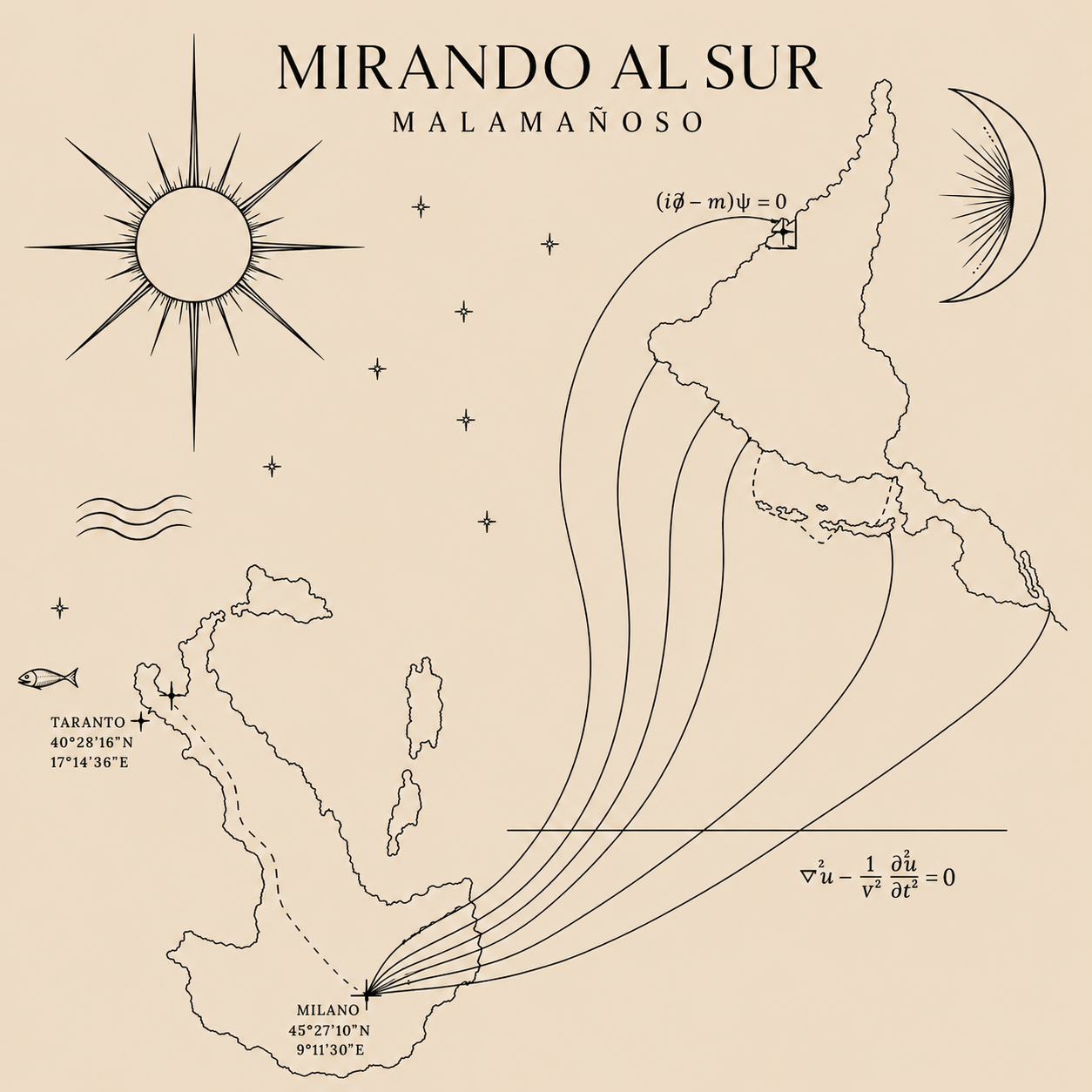
M: There were several connections. I really like Vinicio Capossela, and one of his works made me think about the idea of geographically looking toward another place. Then I travelled to Uruguay and discovered Joaquín Torres García and his idea that “our north is the south.” That’s when everything started to connect. I thought: that is exactly what I want to say. That’s also why I drew the album cover myself.
AR: You drew it?
M: Yes. By hand, in pencil. I took inspiration from Torres García’s work, but adapted it to my own story. Italy appears, there are coordinates for Taranto and Milan, musical staff lines travelling toward Latin America… There are lots of small messages. I wanted to represent my own map of the world. Because ultimately we all learn geography and history from a certain perspective. I grew up with a European view of the world, and later, through travelling and discovering other cultures, you understand that the map can be seen in many different ways. Mirando al Sur is also about that.
AR: Going back to your move from Taranto to Milan, what did you find there that you knew you could never have found by staying in Puglia?
M: Milan shaped me enormously. The dance academy was fundamental because that was where I ultimately decided I wanted to dedicate myself to music. But Milan also gave me love, artists, musicians and teachers who, from Taranto, I could only ever watch on YouTube. It allowed me to meet them in person, study with them and enter different environments. And it brought me much closer to Latin American culture. There was already a connection before that: one of my aunts is Ecuadorian. But in Milan that connection became much stronger. In fact, when I was studying music with my best friend Lorenzo, we used to joke that we wanted to marry Latina women. In the end, we both did. [Laughs.] Milan gave me beautiful things and difficult things too. But I’m grateful for all of it.
AR: There’s a constant feeling on the album that the people you’ve met eventually make their way into the songs.
M: Absolutely. Now I write a lot about things that happen to me or to people I know. “Respira”, for example, comes from personal experiences. “Tu Lugar” continues a story I had started with an earlier song, written during a difficult period in my relationship. Now it speaks from another place: from the way I experience the love I receive. “Huellas” comes from the story of a friend who lost her husband. I try to make sure there is always some truth behind what I write. I’m not interested in writing something just because a line sounds beautiful. I want there to be something real behind it.
AR: And then there’s “Latin Café”, which almost feels like a manifesto for Malamañoso.
M: For me, it’s the song that best explains the project. My wife was part of a dance company called Latin Café 2.0, where they mixed traditional Latin American dances with urban and contemporary languages. One day I went to watch a rehearsal and I thought, “They are doing with dance exactly what I want to do with music.” It was a revelation. In “Latin Café” there’s Peruvian festejo, swing, jazz, Afro-Cuban conga, Uruguayan candombe… Everything is there. It’s almost like answering all the people who spent years telling me, “You can’t mix those things.” Well, there you go. There it is.
AR: The risk, when so many languages coexist, is ending up with a kind of catalogue: now salsa, now candombe, now funk. How do you stop the album from becoming that?
M: By playing. I don’t think of each song as, “Now I’m going to make this genre.” What we do is fusion. We call it Latin Beat. I like that concept because it doesn’t mean we’re only making Latin music. There’s also the European side, my way of understanding music, my background in jazz, rock and funk. It’s not one specific thing, and at the same time it’s many things.
AR: But when you work with musical traditions that are not your own, another conversation inevitably appears: cultural appropriation. How do you approach that?
M: I take it very seriously. My first album with Malamaña was called Vengo con Respeto precisely because of that. I was an Italian playing music that belonged to other cultures. I always try to study as much as possible before playing something. If I want to work with Afro-Cuban music, I study with Cuban musicians. In Milan I studied with Rodney Barreto, who has played with Havana D’Primera. When I went to Uruguay, I studied candombe with teachers there. I try to go to the root. Because there are details you can’t learn just by listening to a record: how a conga is played, where a certain hit comes in, what a rhythm means to people who grew up with it. The line can be very thin. I don’t want to appropriate anyone’s culture. I love Latin America, and precisely because of that I try to approach it through respect and study.
AR: You talk about “Latin Beat.” But “Latin” is also a label largely constructed by the US music industry to place enormously different types of music under one category. Do you still need the word “Latin” to explain Malamañoso?
M: I’d never thought about it exactly like that. I think this album is going to define a lot of what we do from now on. What matters to me is that Malamañoso isn’t understood as salsa or simply as “Latin music.” That’s why I prefer to say Latin Beat. Because I can include the European side in there too. I want both to be present.
AR: While the industry seems increasingly obsessed with individual songs that work on TikTok or Instagram, you’ve built an album around a very specific idea. Why do you still believe in the album as a format?
M: I work a lot on strategy with Emilio, my manager. He understands that side much better than I do. I’m a musician. I need people I trust who can tell me, “This song could work better as the first single,” or “This one should come out earlier.” I listen to those opinions because I have to learn too. But then there’s my artistic side. I don’t want to create solely with TikTok, Instagram or numbers in mind. Obviously numbers help, but my main goal is something else. If you listen to my music, it moves you and you understand the blend I’m trying to create, then my job is done.
AR: That freedom also creates a problem when you take the album on stage. How do you turn such a complex record into a live set?
M: That’s another challenge. “Latin Café”, for example, completely defines Malamañoso, but playing it exactly as it was recorded is very difficult because it requires a lot of musicians. So you have to find solutions. You can turn it into an intro, change the arrangement, play around with it. But that’s exactly what fusion gives you: freedom. You can transform your own songs.
AR: “We Got the Rhythm” introduces another layer: a bilingual song with American funk, Latin music and you being Italian. How did it come about?
M: At that time I had gone back to listening to a lot of James Brown, ’80s Michael Jackson and Bruno Mars. I was also listening to Cimafunk, who works precisely with that connection between funk and Cuban music. And I started thinking about Latino musicians arriving in New York in the ’70s and ’80s. Puerto Ricans and Cubans brought their music with them and there they encountered jazz and funk. New things were born from those encounters. I wanted to do something similar from my own reality. I’m neither Latino nor American. I’m Italian. But I grew up playing jazz and funk, and later I studied Latin music. So I built a funk track with a salsa tumbao underneath and brass that moves between both worlds. Then I thought: for the English vocal, I want an American singer. I found a girl from New Jersey on Instagram. She didn’t have millions of followers or anything like that. I contacted her simply because I thought she was extremely good. That matters to me too: finding talent, not numbers.
AR: Your project is built around fusion. So the opposite question would be: what have you deliberately chosen not to fuse?
M: For now, for example, I haven’t wanted to bring in reggaeton. Not because I think it’s bad. There’s reggaeton I like: Daddy Yankee, Nicky Jam… But I haven’t felt the need. For this album I wanted to work with languages I felt confident in and had studied more deeply: jazz, funk, salsa, traditional Latin American music… If I do reggaeton one day, I’ll have to find my own way into it. It needs a different language. I’m quite self-critical. I try to go only as far as I feel I can make something meaningful.
AR: If Mirando al Sur were a single scene in a film, what would be happening?
M: It would be a journey. A boy leaves a small city looking for something he can’t yet define. He travels between Europe and Latin America trying to bring two cultures together. One belongs to him by origin and the other doesn’t, but he feels an enormous passion for it. And during that journey he tries to build a bridge. That’s what Malamañoso is to me: a bridge between Europe and Latin America. I always tell the musicians who join the project the same thing: I don’t just need you to come and play. You have to put a little piece of your heart into it. Otherwise, it doesn’t work.
AR: Was there any song or rhythm that was originally part of Mirando al Sur but that you ultimately decided to leave out?
M: Yes. A plena that I wrote when I was in Uruguay. It didn’t make the album because I still felt something was missing. Emotionally, it wasn’t finished. And I’d rather wait. There’s also the financial side. Making a record with real musicians costs a lot of money. I have musicians for live shows and different musicians for studio work because they are different jobs. In the studio you are completely exposed. Every detail matters. So you have to decide where to invest your time and money. That song will come later.
AR: Which artists were around you while you were making the album?
M: So many. Fito Páez influenced the writing quite a lot on songs like “Huellas” or “Donde Nace el Sol.” There was also Marc Anthony, Bruno Mars, Anís, Stromae… “Respira”, for example, has a lot to do with what I felt while listening to Stromae’s Multitude. But it’s never about copying. You hear something and think, “This is giving me an idea.” Then you have to transform it until it sounds like you. Until it sounds like Malamañoso.
AR: After so many journeys and influences, what part of Francesco is still unmistakably from Taranto?
M: [Laughs.] Complaining. I complain a lot. I also have this tendency to get stuck when someone hurts me. I think, “I gave you so much, why did you do this to me?” And I can get trapped in that loop. There’s the anxious Francesco, the hypochondriac Francesco, the Francesco who still has insecurities. A lot of that comes from my history, my family, Taranto. I’m working on those things now, also with psychological support. I don’t want to erase that root because it’s part of me. What I want is to improve my relationship with it. I used to be much more explosive. Now I try to be a lot more zen. [Laughs.]
AR: What advice would you give to someone very young who wants to enter the music industry today, when everything seems to begin and end with numbers?
M: I don’t want to simply say, “Believe in yourself,” because everyone says that. I’d say you need real passion. The industry constantly pushes you toward numbers now: numbers, numbers, numbers. It feels like if you don’t have certain figures, you are nobody. You can’t let that completely define what you do. If you want to be a drummer, study drums. If you want to sing, study. If you want to write songs, write. Take the craft seriously. And then be self-critical, but not in order to destroy yourself. Be self-critical so you can grow. I also believe strongly in setting goals: small goals, medium-term goals and big ones. Ask yourself where you want to be in five or ten years. I know where I want to be.
AR: After making an album about looking south, where is Malamañoso going to look next?
M: The identity isn’t going to change. That essence will stay. But now I want to move Francesco and Malamañoso to Madrid. I want to be somewhere where I’m happy because I know that if I’m doing well, I’ll be able to keep creating. And above all, I want to play live. The music is already there for anyone who wants to listen to it, but now I want to look people in the face. I want to see how they react. I want them to have fun because of what we do. Even if someone comes up to me afterwards and says they didn’t like something, that helps me. That helps me grow too. After spending so much time building this project, now I want to take it out of the studio and put it in front of people. That’s where the next chapter of Malamañoso really begins.
Questions by @alraco43