
THE GARDEN WITHIN THE UNIFORM: THOM BROWNE AND THE ENDURING POWER OF FANTASY
Menswear has spent the past several seasons immersed in a search for pragmatism. In a landscape shaped by economic uncertainty, the rise of quiet luxury, and an increasing demand for versatile garments, much of the contemporary conversation revolves around concepts such as functionality, smart investment, and the construction of a long-lasting wardrobe. Collections are increasingly evaluated based on their ability to integrate seamlessly into everyday life, and desirability seems more closely tied to utility than ever before.
Against this backdrop, Thom Browne continues to occupy a singular position within the industry: that of a designer who still champions fashion as a space for storytelling.
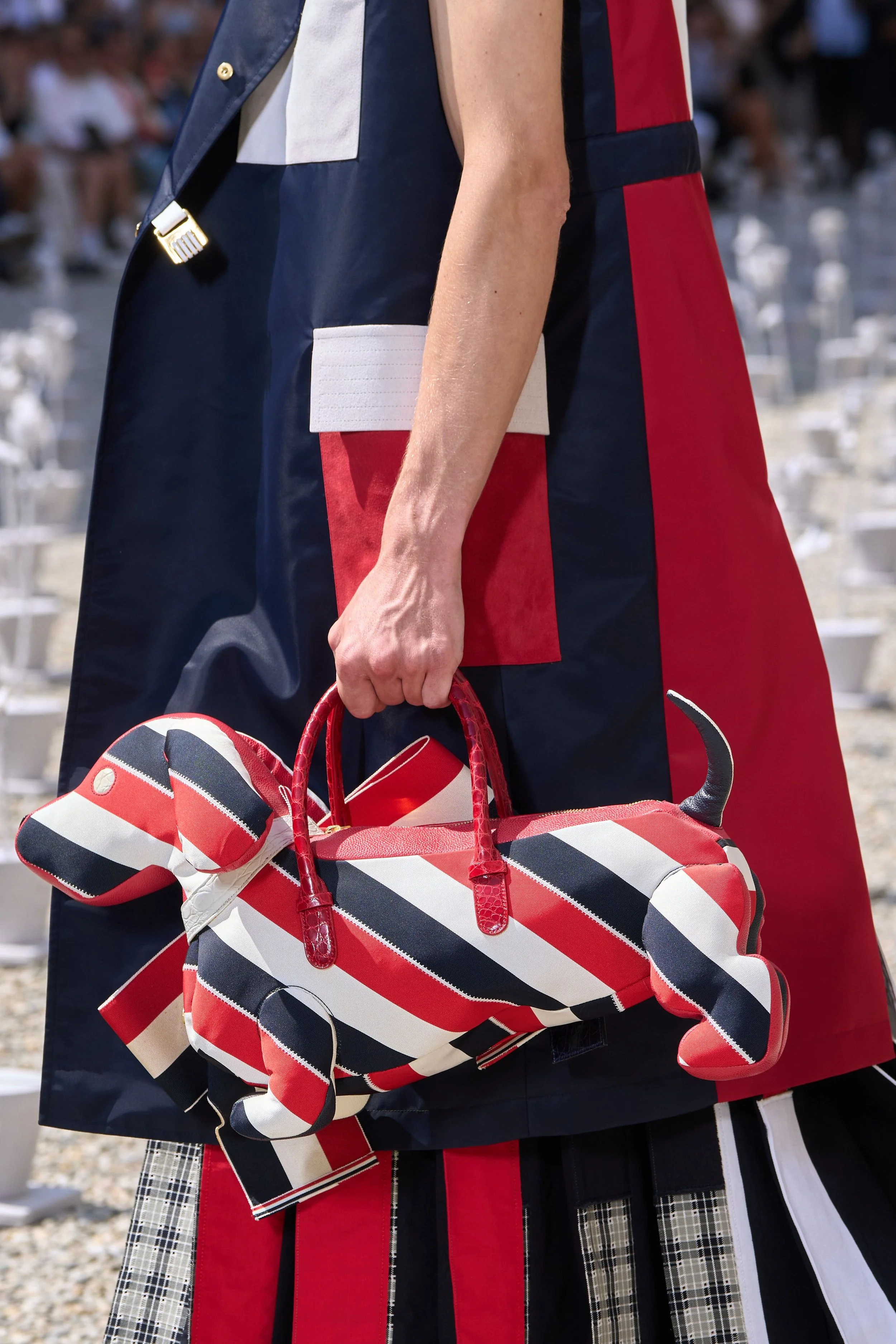
His Spring/Summer 2027 collection, presented in Milan, unfolded as a universe inhabited by bees, dragonflies, butterflies, and references to gardening. Models walked the runway carrying watering cans, wearing beekeeper-inspired hats, and showcasing intricate embroideries that transformed garments into miniature narrative surfaces. At first glance, the collection appeared to operate within a purely fantastical, almost childlike realm, seemingly detached from the concerns currently dominating the menswear conversation. Yet beneath this exuberant staging remained the element that has defined Browne’s work for more than two decades: the suit.
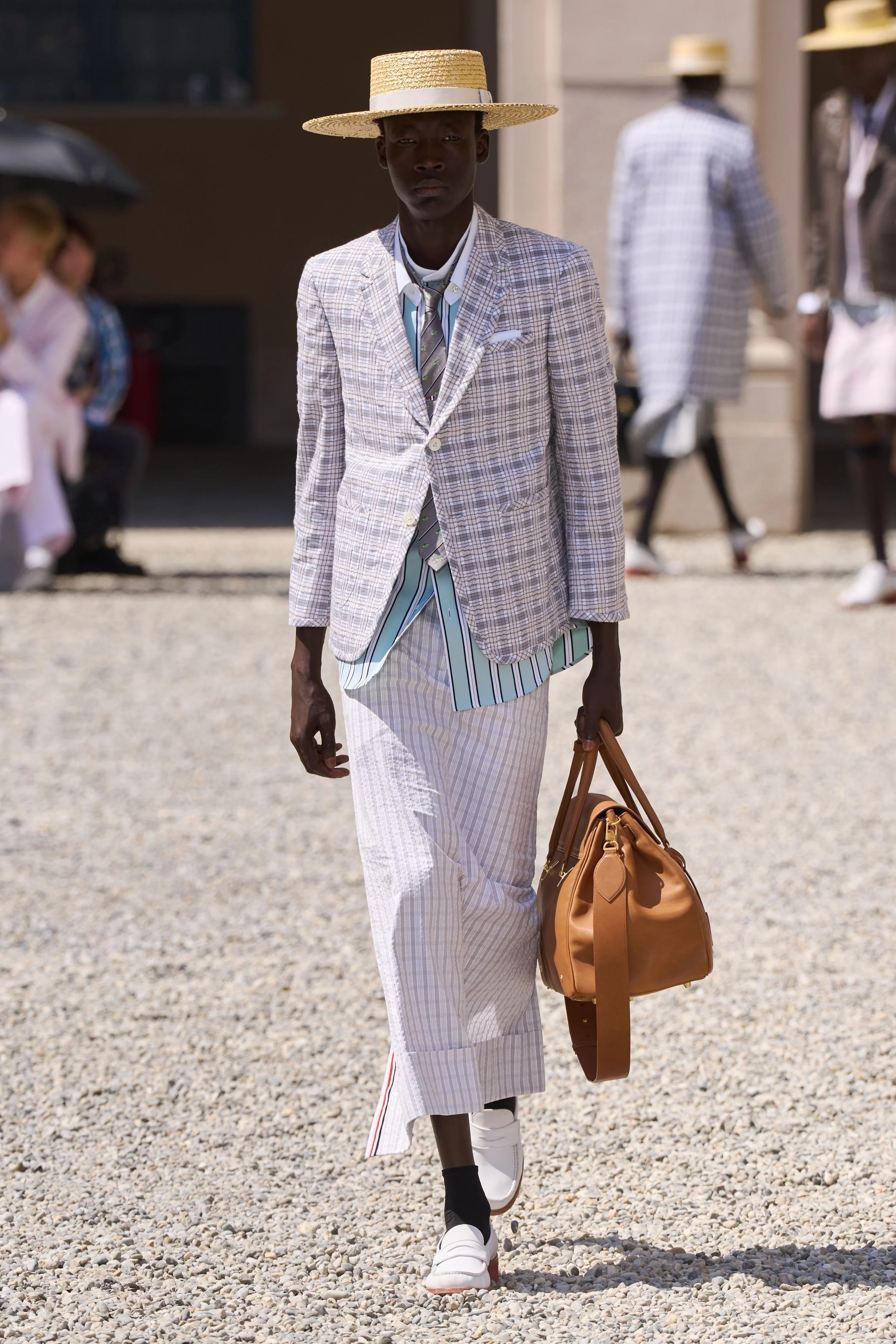
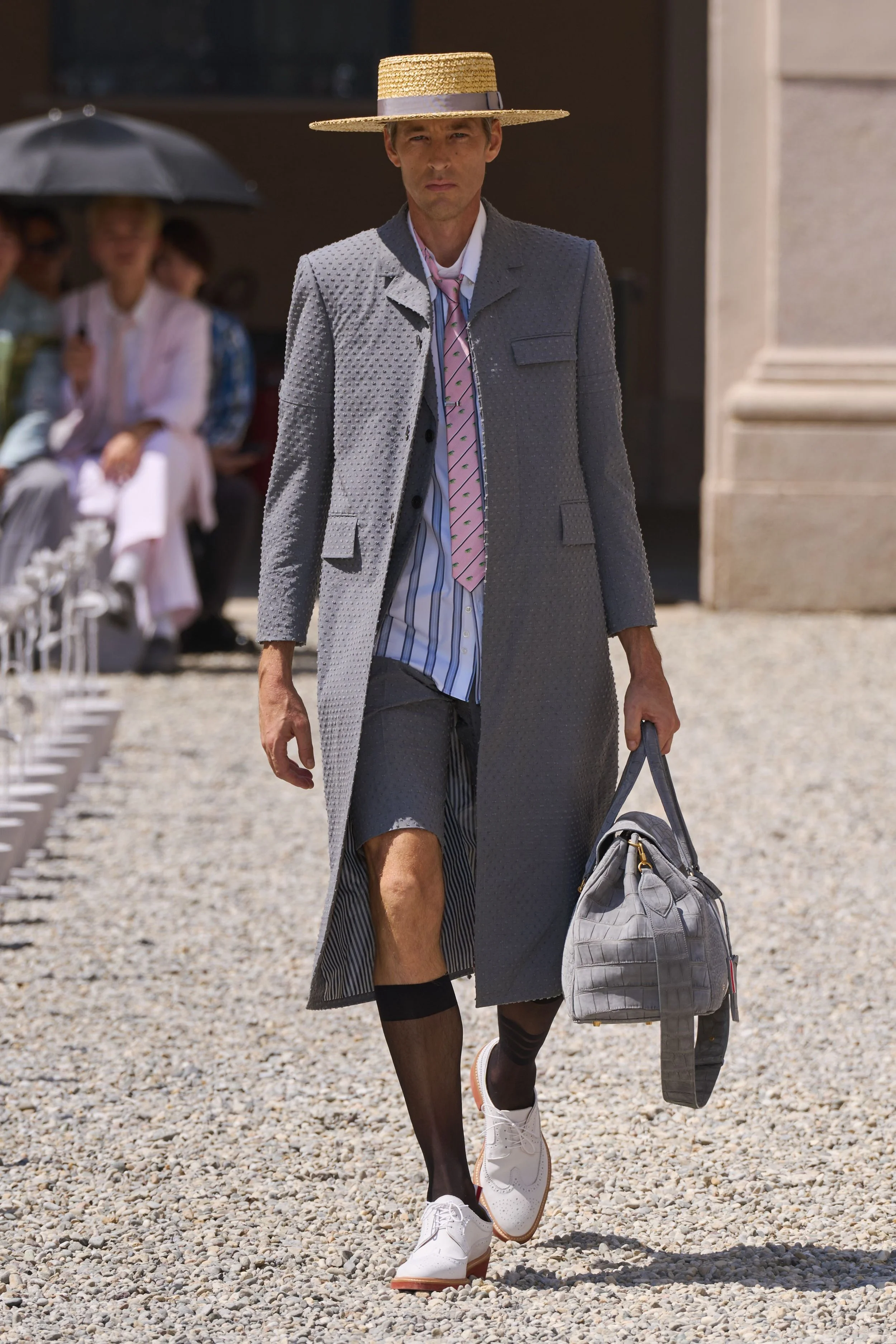
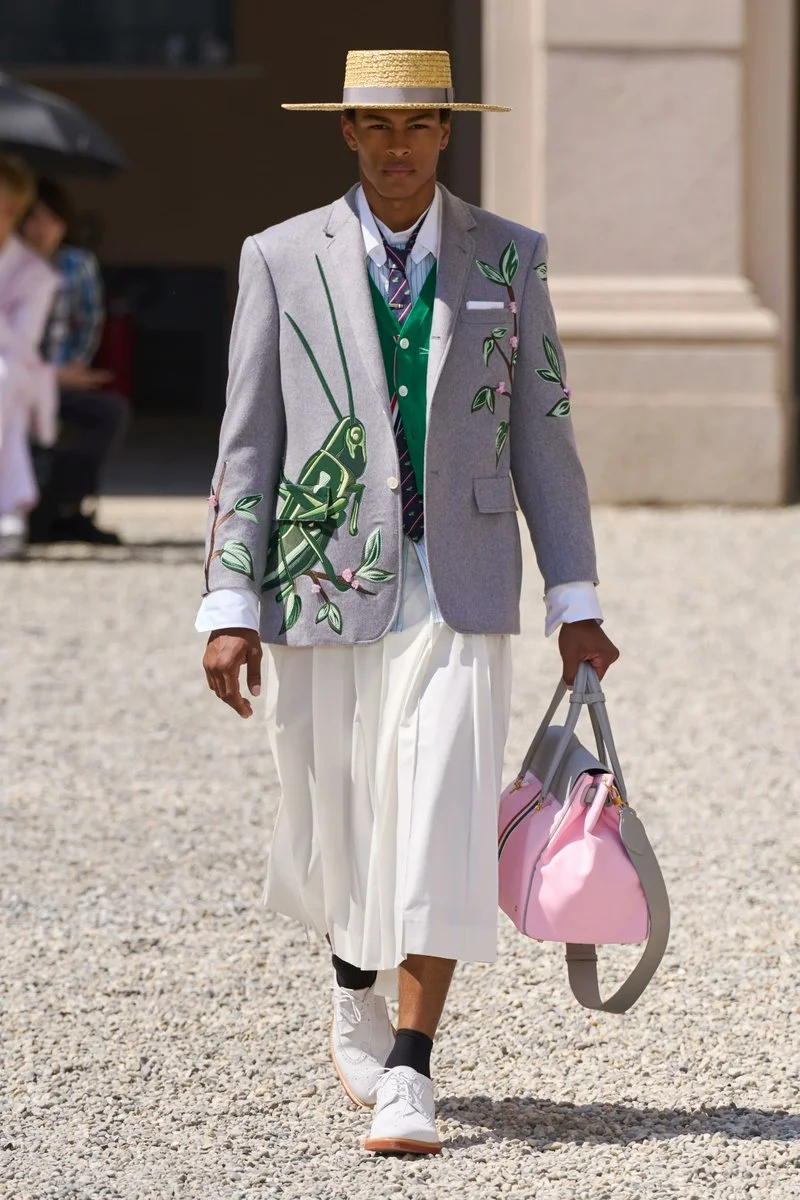
Far from representing a departure from his established language, the collection reinforced one of the constants of his practice. While much of the industry pursues novelty through new silhouettes or radical aesthetic shifts, Browne has built his creative universe through repetition. Cropped jackets, altered proportions, school uniforms, grey tailoring, and preppy codes reappear season after season, functioning as a stable vocabulary upon which different narratives can be constructed. His work is less about reinventing garments than about reinterpreting the meanings they can contain.
It is significant that, on this occasion, he turned to the world of insects. Bees in particular represent one of nature’s clearest examples of organization: they operate through hierarchical structures, precise routines, and a collective logic that privileges the system over the individual. In many ways, they embody the same notion of discipline historically associated with the uniform. Yet Browne transforms these symbols of order into decorative, almost poetic elements, integrating them into a proposal where the rigidity of tailoring coexists with imagination.
This tension between structure and creativity has remained constant throughout Browne’s career and feels especially relevant in the current cultural moment.
Perhaps this is why Browne’s ongoing fascination with the uniform remains so compelling. His collections do not present freedom as the absence of rules, but rather as something that emerges from within them. The repetition of certain forms does not limit creativity; it enables it. The suit becomes a stable framework capable of accommodating multiple fictions, from school-inspired references to imaginary gardens populated by hand-embroidered insects.
Historically, clothing has never been solely a matter of protection or utility. It has functioned as symbol, representation, ritual, and a mechanism of transformation. Fantasy is not an escape from reality, but a way of reinterpreting it. From this perspective, the bees, flowers, and gardens that appeared on the runway should not be understood merely as decorative motifs. They are narrative devices that allow Browne to explore an idea that runs throughout much of his work: the possibility that discipline and imagination are not opposing concepts, but complementary ones.
More than a collection about nature, Spring/Summer 2027 was a reflection on the possibilities that the uniform still offers. In a season defined by the pursuit of simplicity and functionality, Browne once again demonstrated that menswear can still make room for surprise, theatricality, and the construction of self-contained worlds without abandoning the codes that sustain it. The suit remains intact, yet its meaning continues to evolve.
Words by @adrianabarbado